
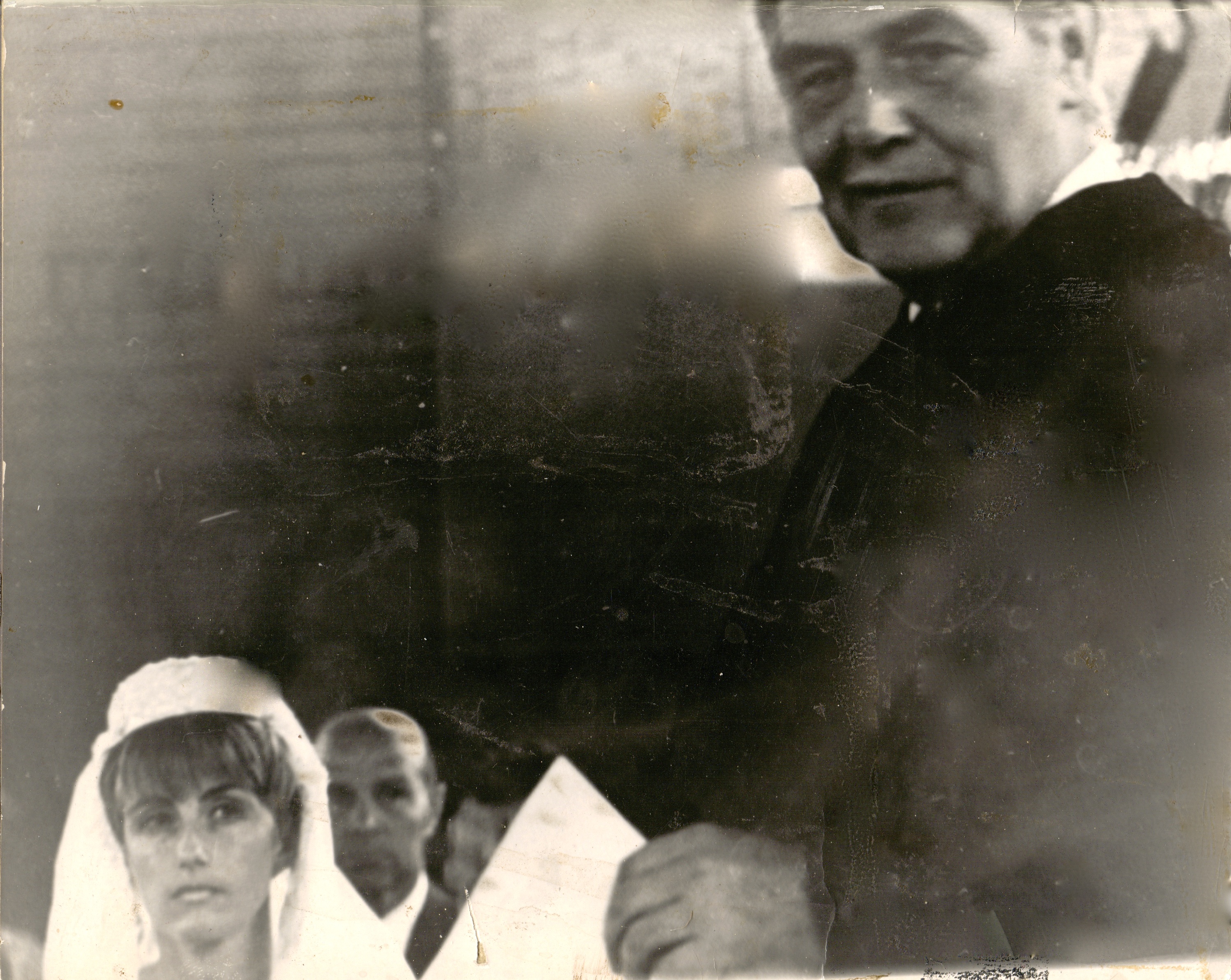


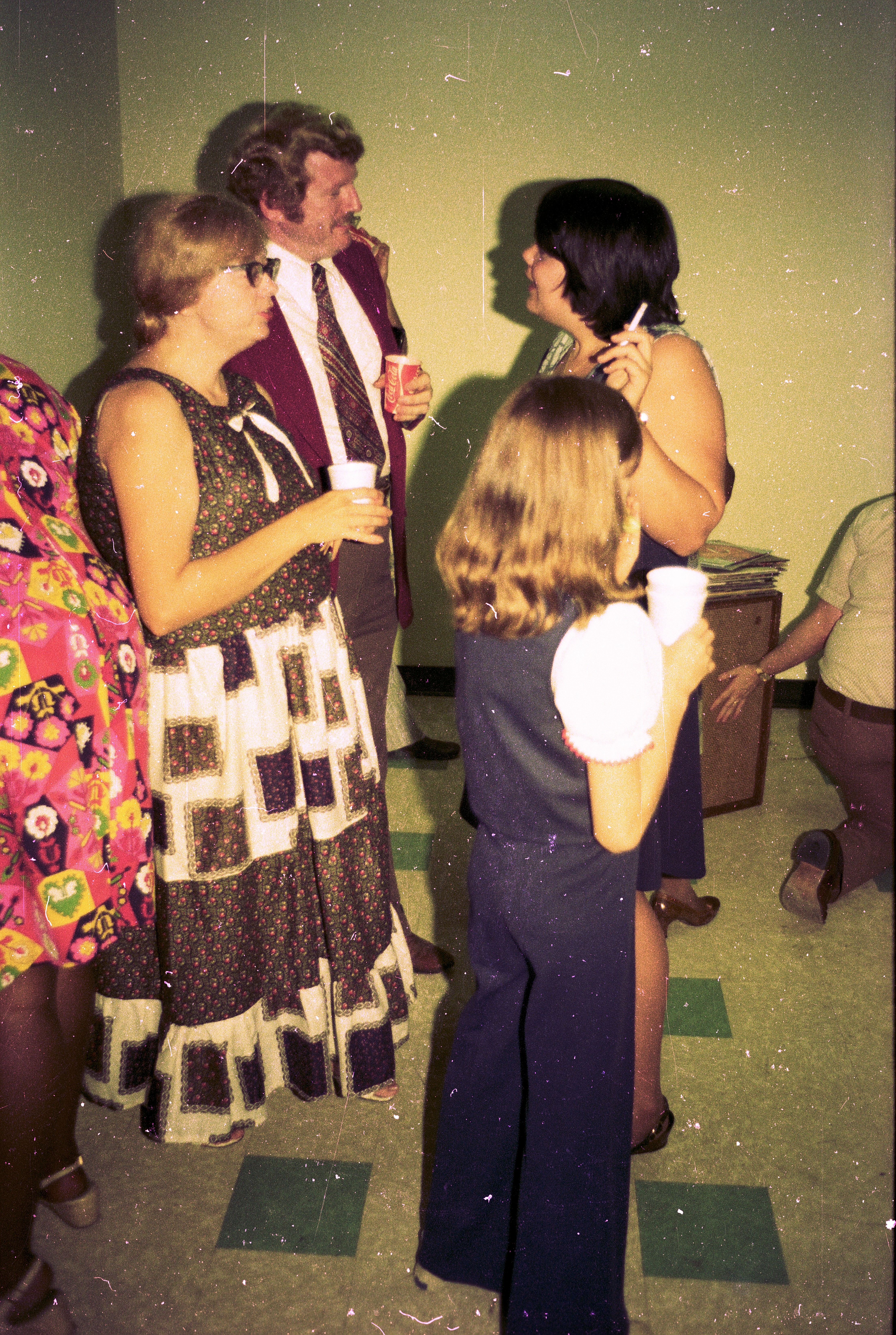
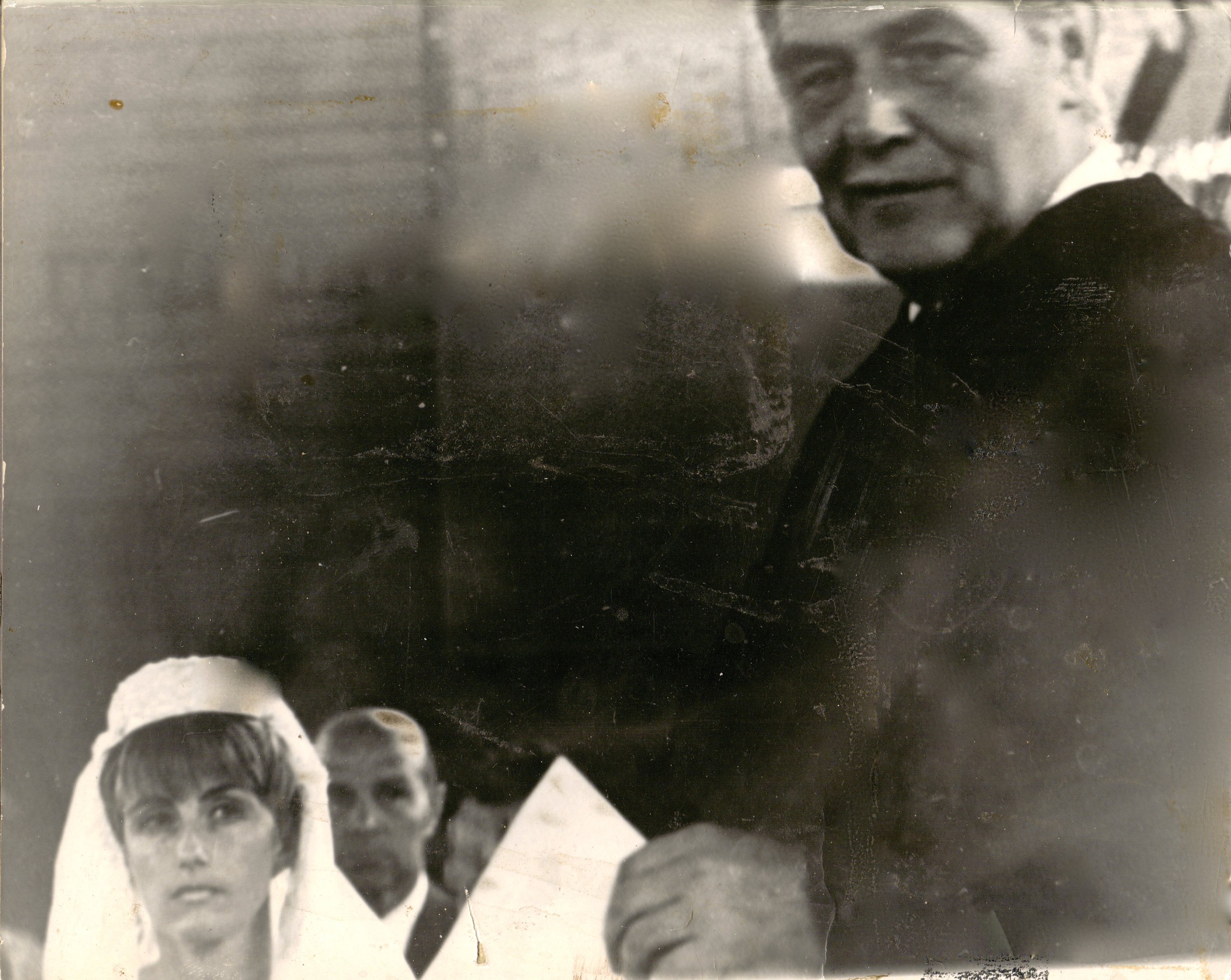
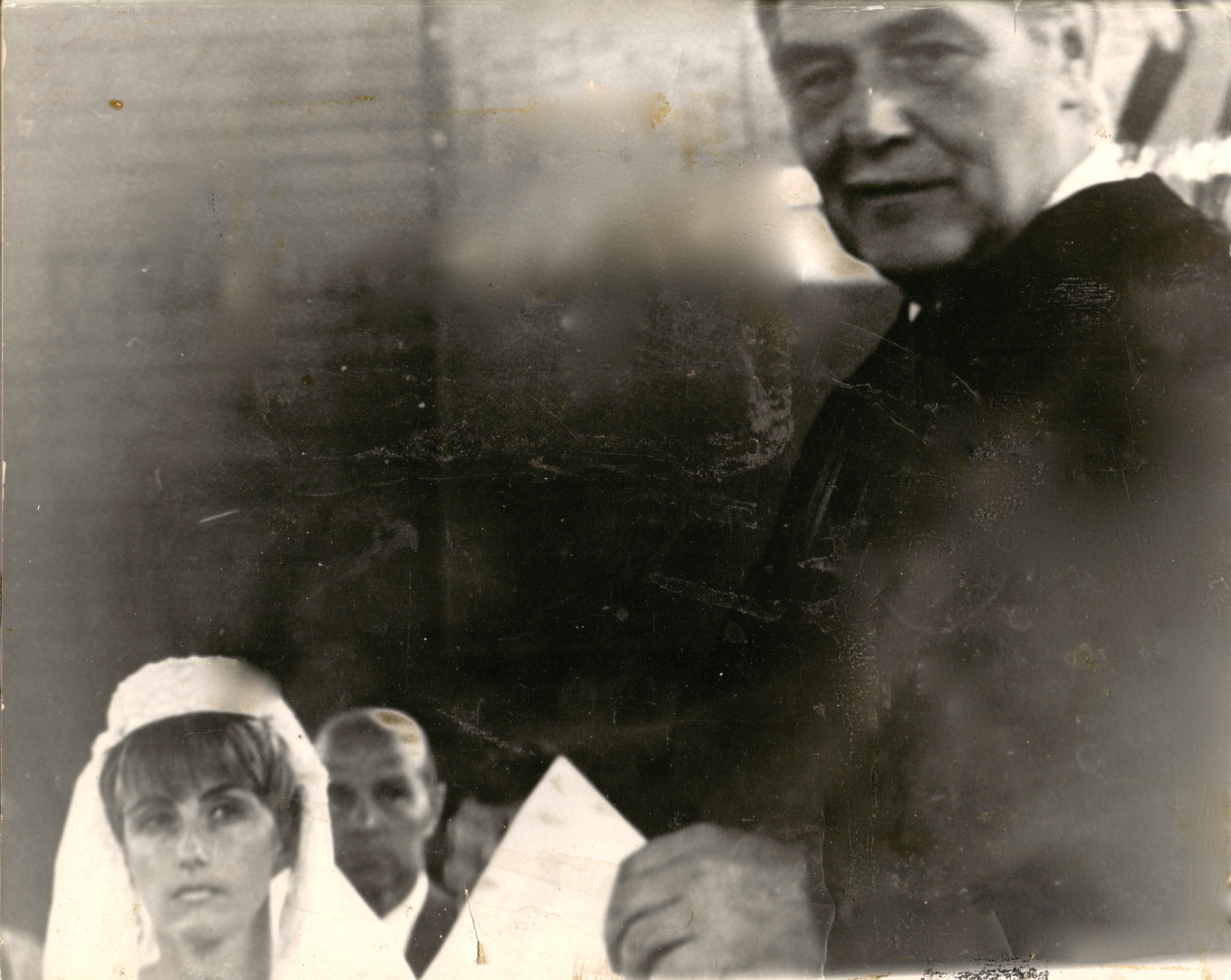
Is that lovely bride Kay Lush? Marilyn
On Apr 28, 2022, at 10:41 AM, Frank Knutson via OE <oe@lists.wedgeblade.net> wrote:
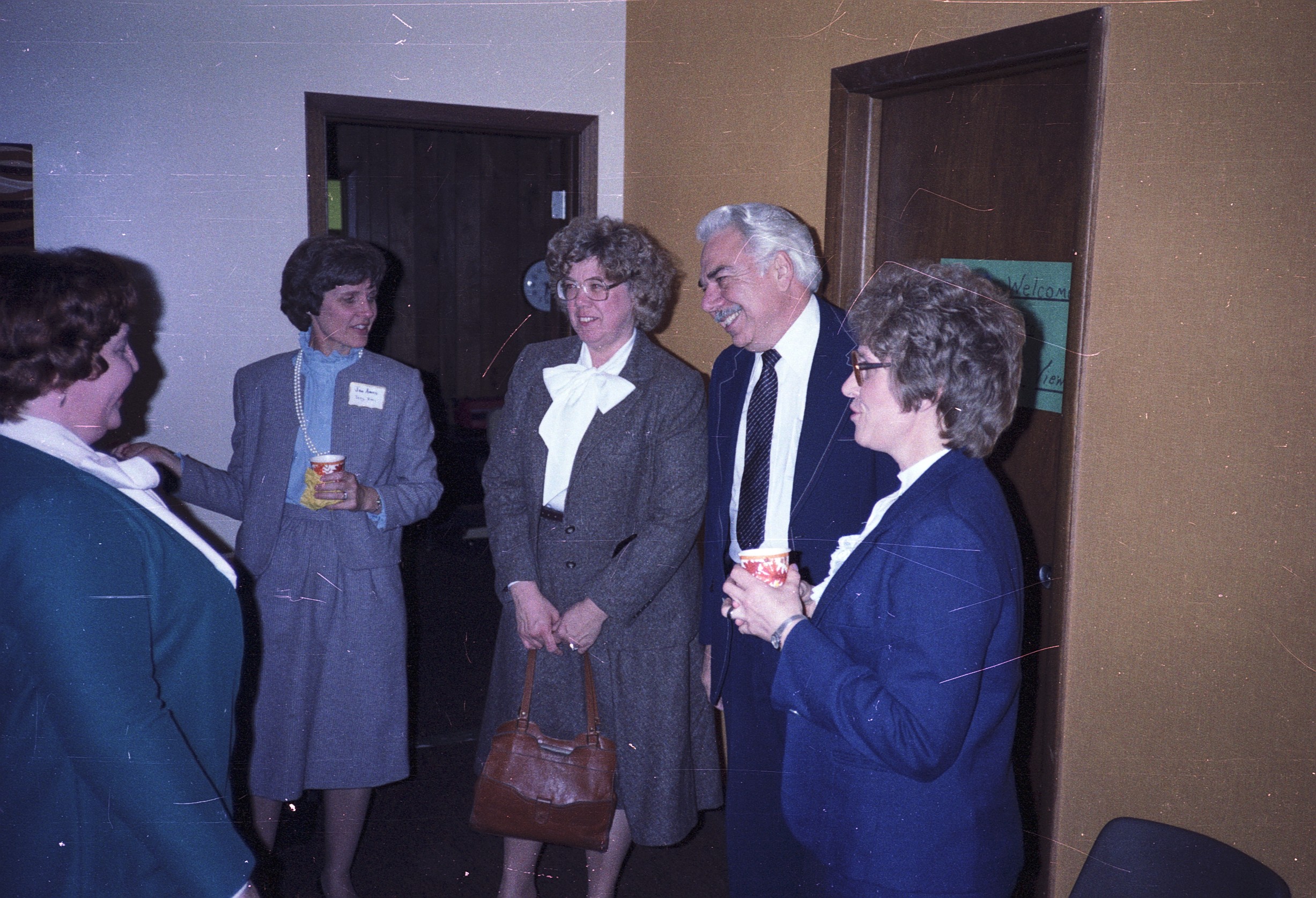
<Joseph Wesley Mathews - 063.jpg><Joseph Wesley Mathews - 064.jpg><Meeting.jpg><RH-WashingtonOthers-7.jpg>
<1554442_10151886523628581_1513334308_n.jpg><clip_image002.png>
_______________________________________________ OE mailing list OE@lists.wedgeblade.net http://lists.wedgeblade.net/listinfo.cgi/oe-wedgeblade.net

Looks like some photos from the hearing after the riots. Who went with Joe on that trip to DC? Lynda From: OE <oe-bounces@lists.wedgeblade.net> on behalf of OE List <oe@lists.wedgeblade.net> Reply-To: OE List <oe@lists.wedgeblade.net> Date: Thursday, April 28, 2022 at 10:44 AM To: OE List <oe@lists.wedgeblade.net> Cc: Frank Knutson <frankknutson2@gmail.com> Subject: [Oe List ...] 4/28/22 PHOTOS [cid:image001.jpg@01D85B38.BCDAED30][cid:image002.jpg@01D85B38.BCDAED30][cid:image003.jpg@01D85B38.BCDAED30][cid:image004.jpg@01D85B38.BCDAED30] [cid:image005.jpg@01D85B38.BCDAED30][cid:image006.png@01D85B38.BCDAED30]

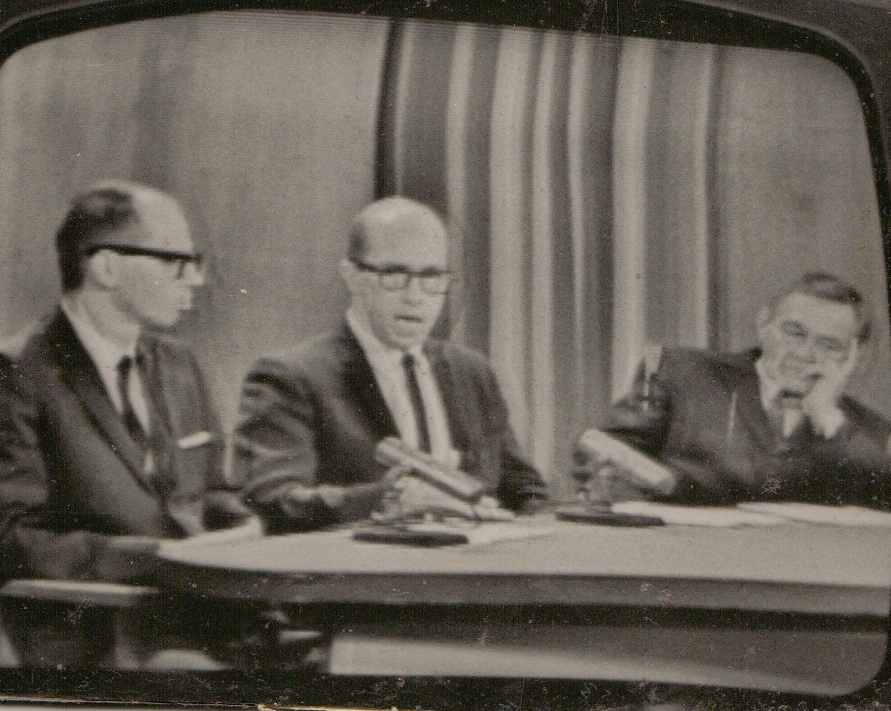

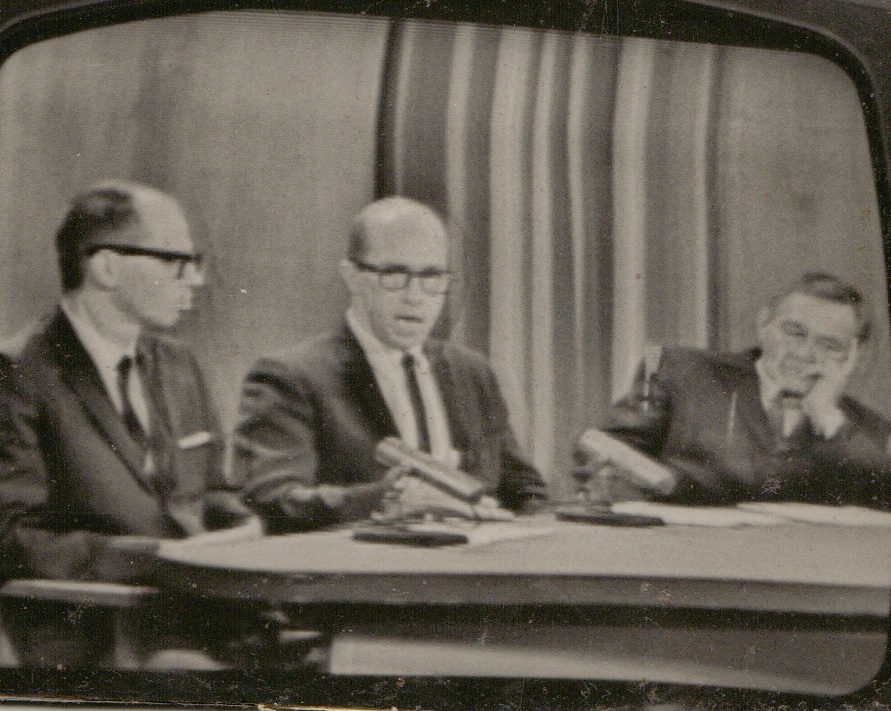
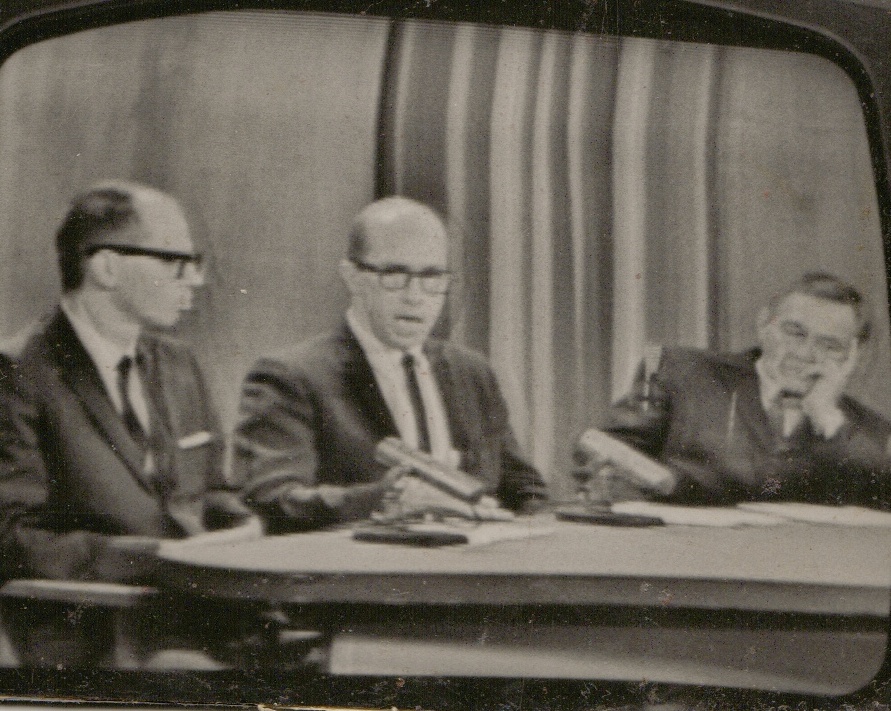
Lynda, that looks like a picture of a television screen -- Could that be David McCleskey on the left? I vaguely recall something about a series done in Texas --- This from Letter to Laymen (CFLC) in March of 1962 : "A pilot television presentationutilizing this approach to serious conversation and art has been madeby the Community (a transcript of which is on page three) incooperation with a New York television production company and movieproducer Stanley Kramer." Full text here: THE RADICAL DEMAND TODAY We areliving in an new age. It is a time of radical and comprehensiverevolution. In a manner of speaking. Western Civilization has reachedan end. Our total world view is undergoing transmutation affectingevery part, as well as the whole, of the human enterprise ofcivilization. Not only has Ptolemaic cosmology of the Middle Agesvanished, but Nations once modern model of the world as a greatmachine has dramatically collapsed. The expanding universe of Dr.Einstein is now penetrating every concept of life and image ofhistory. Man is launching forth on a brand new venture. Thishistorical crisis is not basically theoretical or abstract. On thecontrary, what is happening to us is very practical, very concrete.It is at once thoroughly personal and utterly social. Furthermore,the center of the revolution is located not in the political oreconomic facets of the civilizing adventure, but in the culturaldimension. "Culture" here means the common sense, thecommon symbols. and the common life-style of a people. Preciselybecause it is in these areas of our life where the present upheavalbecomes manifest, the center of gravity of the whole social body hasbeen shaken. And therefore, every sensitive and reflective individualon the street is deep]y involved. Of this he is aware, howeveruneven]y this awareness may be distributed among men. Our commonman is certainly frightened by the new world about him, but cynics tothe contrary, he is also excited. He is acutely experiencing hisuniverse as complex, impersonal, mysterious, routine, paradoxical,tragic, capricious and so on. This is frightening indeed. Yet thesame individual is raising anew and in depth the question of what itmeans to be a real human being in the midst of this. Underneath thesuperficial readings, the reflective every day person is not reallytrying to ignore, dismiss and escape the new world and its demands.Rather, he is asking for practical images, symbols and more patternswhich will illuminate this new age and enable him to participatecreatively and as a genuine person, in the forging of the newresponses, personal and social, that the age requires. This need ofthe "average" man brings us to the artist and his work. THEROLE OF ART Art ishuman. It is necessarily a part of human life in both itsindividualization and socialization. It is not limited to specialgroups such as the leisure class or the intellectual strata. It is anessential part of life for all men. However unequal the exposure ofmen may be to significant art or the capacity of men to besignificantly present to art, no one can or does live without it.Here are unveiled the very basic questions: Is the art we live beforesignificant? And howdoes one live significantlybefore art. Let us turnfirst to the question of whether the art to which one is exposed isgood or bad, true or false, adequate or inadequate. For our presentpurposes, three issues are raised: Integrity, relevance and utility.Does the artist speak THE ROLE OF ART (continued from page one) honestlyabout the human situation in his time? Does his work deal importantlyand compellingly with the basic and actual human needs and concerns ofhis world? Does it call forth in the viewer the kind of images thatwill enable him more adequately to forge his responses to the realworld about him? To speak of art in this fashion, is to insist thatart has a vital functional role in culture and society. Indeed, weare seeing today that art is very utilitarian in the rich and freshsense of genuinely contributing to the inner workings of the greatcivilizing venture of man. Such a viewinsists that art is not a sophisticated capstone that is added tosociety when the basic tasks are done. It is rather an essentialingredient of society that affects the whole and every part, at everymoment. Furthermore, it follows that the role of art is not an escapevalve for the sophisticate at the end of an era, as many are wont tothink. Its most crucial hour is at the beginning of a new age whennew images are required. Indeed the very function of art is toquestion and destroy old, false, inadequate images and to prompt andcreate new authentic and useful models for practical human response.The everyday reflective man of our time is crying, as we have seen,for exactly this kind of assistance. Perhaps thisis the clue to the interest in art that our age is experiencing whichin depth and scope and variety has no equal in all history. In brief,there is emerging in the new world a fresh understanding of thefunction and place of art in civilization. To fulfill her role today,however, art may need an ally: serious conversation. This brings usto the third focus of the PROVOCATION series. (see page three) THEPLACE OF SERIOUS CONVERSATION Seriousconversation itself might well be considered an art. Not simply inthe sense of a skill-it surely is that-but in the sense of an artform. Be that as it may, it seems clear that it is an essentialcatalytic agent to the art form in our day. The contention is thatart, the indispensable midwife to the new man in the new world, isitself in need of a midwife if it is effectively to fulfill its rolein accomplishing significant psychological and social change. The man oftoday, amidst his fears and bewilderments, wants to be aself-conscious historical being. He senses that history is made aswell as experienced and latently, at least, he yearns so toparticipate in it. This is to suggest that behind and in the midst ofthe twentieth century man's more observable struggles, is the problemof intentionality. He is no longer content to be simply a passivevictim of the impressions that play upon his inner history. Heinsists on being self-consciously present to those images andengaging in a dialogue with them. This means that he must becomeintentional about art. The question of PROVOCATION is: How can theman in the street learn to become intentional about the art thatspeaks to him in such a fashion that creative action ensues? Seriousconversation is the means whereby one becomes self-consciouslyattentive in depth to the manner in which he is affected by a work ofart and the means whereby he is enabled to carry on his own dialoguewith the art object. This in turn both prompts and directs decisiveand creative action in the midst of the civilizing process. Authenticdialogue in relation to art, is not primarily an educational endeavorin the sense of accumulating information, though of course this mayhappen in the midst of it. The art object and the way it speaks tothe individuals conversing supplies the content. The seriousconversation, where mind meets mind in reflection upon a commonobject and experience, enables one to articulate the impressions madeupon him and to draw them together for himself into a more or lesscomprehensive complex. This model is then brought to bear upon hisinner and outer historical situation in such a fashion that newpractical insights, meanings and strategies emerge, which bothmotivate and direct his activity. To say this another way, seriousconversation does not intrude ideas or images, but awakens the latentones that are already present, and occasions the birth of new ones.In and through this process, social change is initiated. Art plusdialogue equals intentional involvement in history. To sum up:new and imaginative human responses to life are urgently required bythe new world about us. The art of the times injects into thissituation new images of human possibility. Serious conversationenables the individual to clarify these images in such a fashion thatfresh and imaginative responses can be forged. A pilottelevision presentation utilizing this approach to seriousconversation and art has been made by the Community (a transcript ofwhich is on page three) in cooperation with a New York televisionproduction company and movie producer Stanley Kramer. Jim Wiegel Theunknown is what is. And to be frightened of it is what sends everybodyscurrying around chasing dreams, illusions, wars, peace, love, hate, allthat. Unknown is what is. Accept that it's unknown, and it's plainsailing. John Lennon 401 North Beverly Way,Tolleson, Arizona 85353 623-363-3277 jfwiegel@yahoo.com www.partnersinparticipation.com On Thursday, April 28, 2022, 04:50:02 PM MST, Lynda C via OE <oe@lists.wedgeblade.net> wrote: Looks like some photos from the hearing after the riots. Who went with Joe on that trip to DC? Lynda From: OE <oe-bounces@lists.wedgeblade.net> on behalf of OE List <oe@lists.wedgeblade.net> Reply-To: OE List <oe@lists.wedgeblade.net> Date: Thursday, April 28, 2022 at 10:44 AM To: OE List <oe@lists.wedgeblade.net> Cc: Frank Knutson <frankknutson2@gmail.com> Subject: [Oe List ...] 4/28/22 PHOTOS _______________________________________________ OE mailing list OE@lists.wedgeblade.net http://lists.wedgeblade.net/listinfo.cgi/oe-wedgeblade.net

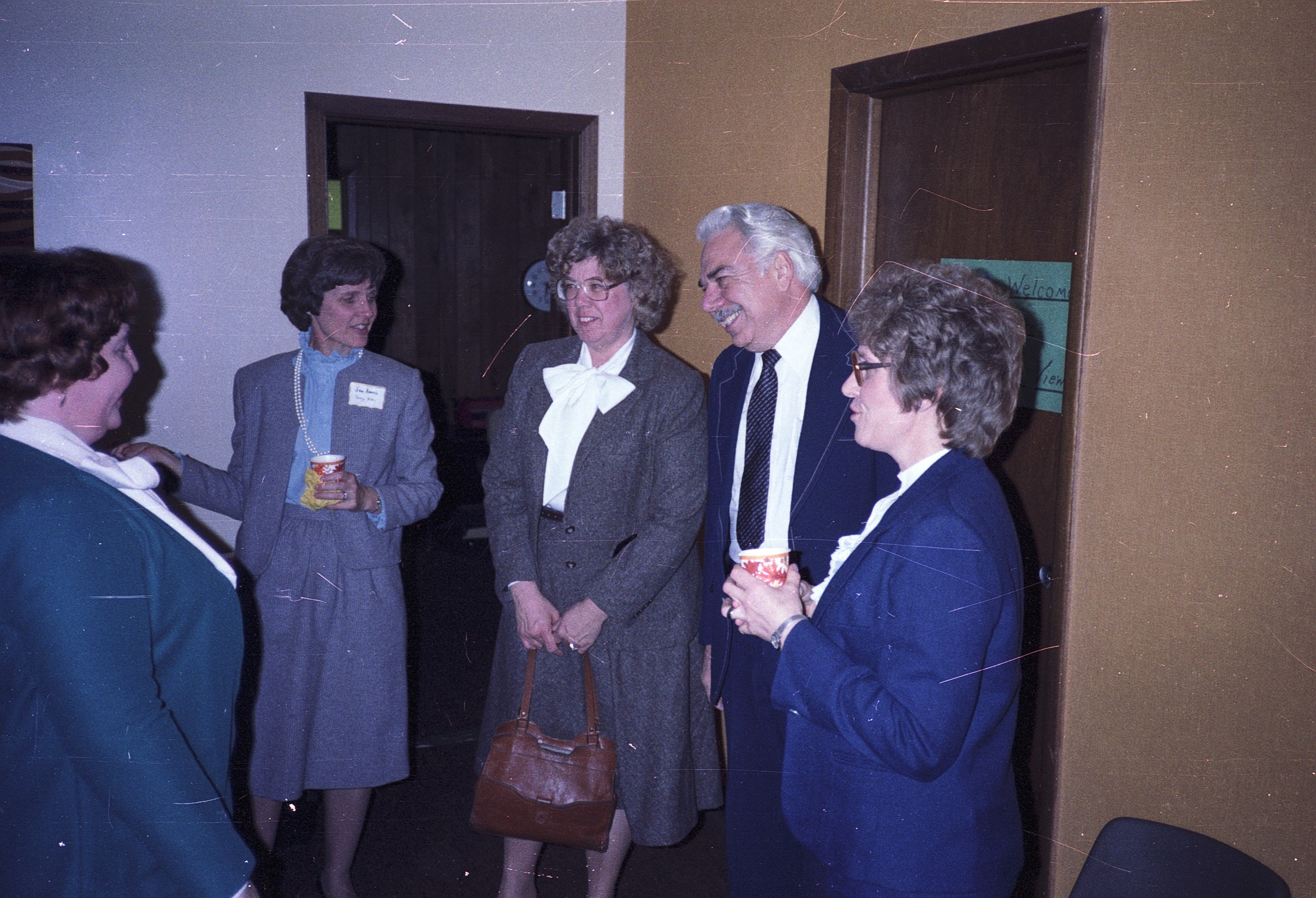
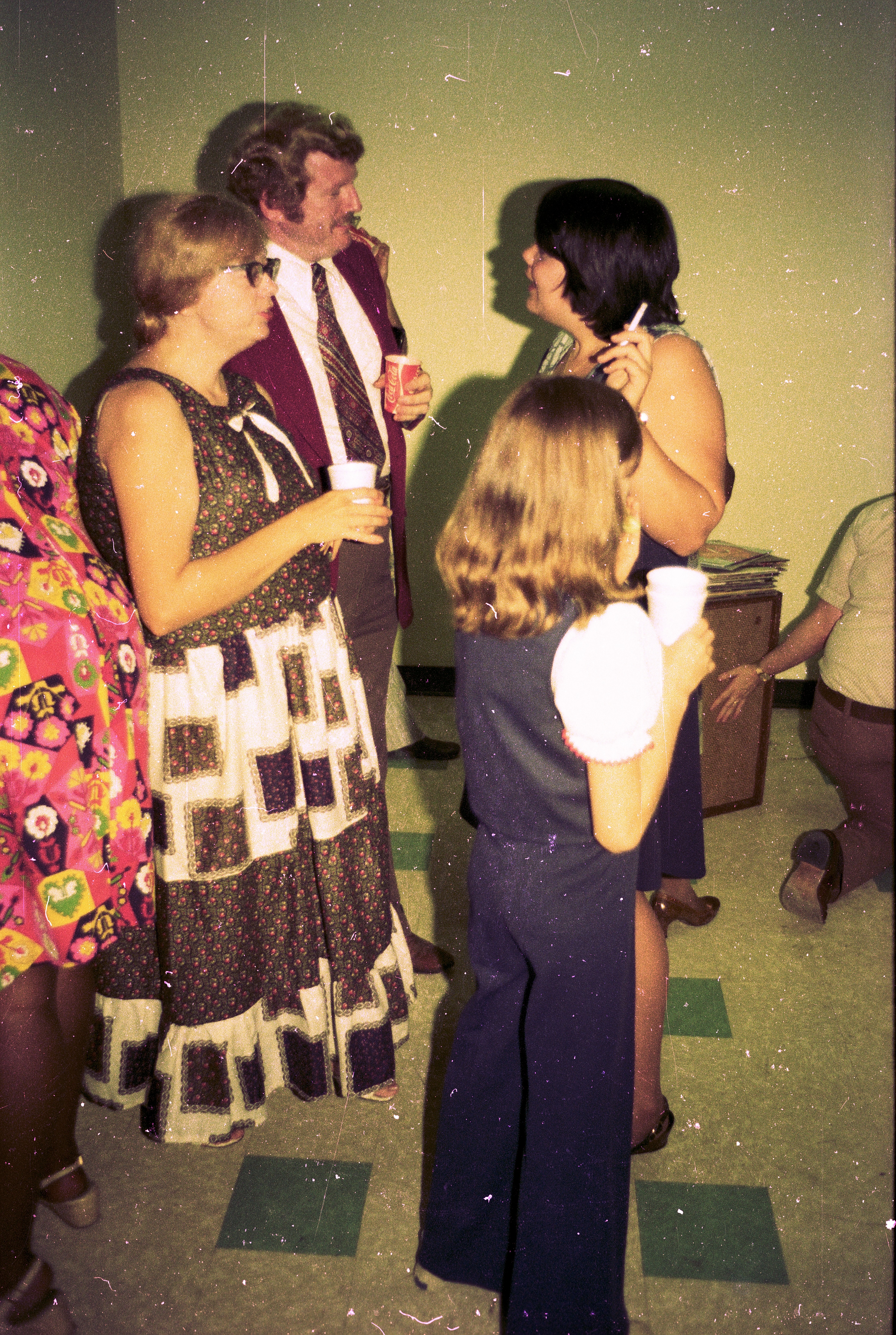

It’s fascinating, Jim, to see the style (and content) of this writing now. Thanks, Terry
On Apr 28, 2022, at 19:30, James Wiegel via OE <oe@lists.wedgeblade.net> wrote:
Lynda, that looks like a picture of a television screen -- Could that be David McCleskey on the left? I vaguely recall something about a series done in Texas --- This from Letter to Laymen (CFLC) in March of 1962 : "A pilot television presentation utilizing this approach to serious conversation and art has been made by the Community (a transcript of which is on page three) in cooperation with a New York television production company and movie producer Stanley Kramer."
Full text here: THE RADICAL DEMAND TODAY
We are living in an new age. It is a time of radical and comprehensive revolution. In a manner of speaking. Western Civilization has reached an end. Our total world view is undergoing transmutation affecting every part, as well as the whole, of the human enterprise of civilization. Not only has Ptolemaic cosmology of the Middle Ages vanished, but Nations once modern model of the world as a great machine has dramatically collapsed. The expanding universe of Dr. Einstein is now penetrating every concept of life and image of history. Man is launching forth on a brand new venture.
This historical crisis is not basically theoretical or abstract. On the contrary, what is happening to us is very practical, very concrete. It is at once thoroughly personal and utterly social. Furthermore, the center of the revolution is located not in the political or economic facets of the civilizing adventure, but in the cultural dimension. "Culture" here means the common sense, the common symbols. and the common life-style of a people. Precisely because it is in these areas of our life where the present upheaval becomes manifest, the center of gravity of the whole social body has been shaken. And therefore, every sensitive and reflective individual on the street is deep]y involved. Of this he is aware, however uneven]y this awareness may be distributed among men.
Our common man is certainly frightened by the new world about him, but cynics to the contrary, he is also excited. He is acutely experiencing his universe as complex, impersonal, mysterious, routine, paradoxical, tragic, capricious and so on. This is frightening indeed. Yet the same individual is raising anew and in depth the question of what it means to be a real human being in the midst of this. Underneath the superficial readings, the reflective every day person is not really trying to ignore, dismiss and escape the new world and its demands. Rather, he is asking for practical images, symbols and more patterns which will illuminate this new age and enable him to participate creatively and as a genuine person, in the forging of the new responses, personal and social, that the age requires. This need of the "average" man brings us to the artist and his work.
THE ROLE OF ART
Art is human. It is necessarily a part of human life in both its individualization and socialization. It is not limited to special groups such as the leisure class or the intellectual strata. It is an essential part of life for all men. However unequal the exposure of men may be to significant art or the capacity of men to be significantly present to art, no one can or does live without it. Here are unveiled the very basic questions: Is the art we live before significant? And how does one live significantly before art.
Let us turn first to the question of whether the art to which one is exposed is good or bad, true or false, adequate or inadequate. For our present purposes, three issues are raised: Integrity, relevance and utility. Does the artist speak THE ROLE OF ART (continued from page one)
honestly about the human situation in his time? Does his work deal importantly and compellingly with the basic and actual human needs and concerns of his world? Does it call forth in the viewer the kind of images that will enable him more adequately to forge his responses to the real world about him? To speak of art in this fashion, is to insist that art has a vital functional role in culture and society. Indeed, we are seeing today that art is very utilitarian in the rich and fresh sense of genuinely contributing to the inner workings of the great civilizing venture of man.
Such a view insists that art is not a sophisticated capstone that is added to society when the basic tasks are done. It is rather an essential ingredient of society that affects the whole and every part, at every moment. Furthermore, it follows that the role of art is not an escape valve for the sophisticate at the end of an era, as many are wont to think. Its most crucial hour is at the beginning of a new age when new images are required. Indeed the very function of art is to question and destroy old, false, inadequate images and to prompt and create new authentic and useful models for practical human response. The everyday reflective man of our time is crying, as we have seen, for exactly this kind of assistance.
Perhaps this is the clue to the interest in art that our age is experiencing which in depth and scope and variety has no equal in all history. In brief, there is emerging in the new world a fresh understanding of the function and place of art in civilization. To fulfill her role today, however, art may need an ally: serious conversation. This brings us to the third focus of the PROVOCATION series. (see page three)
THE PLACE OF SERIOUS CONVERSATION
Serious conversation itself might well be considered an art. Not simply in the sense of a skill-it surely is that-but in the sense of an art form. Be that as it may, it seems clear that it is an essential catalytic agent to the art form in our day. The contention is that art, the indispensable midwife to the new man in the new world, is itself in need of a midwife if it is effectively to fulfill its role in accomplishing significant psychological and social change.
The man of today, amidst his fears and bewilderments, wants to be a self-conscious historical being. He senses that history is made as well as experienced and latently, at least, he yearns so to participate in it. This is to suggest that behind and in the midst of the twentieth century man's more observable struggles, is the problem of intentionality. He is no longer content to be simply a passive victim of the impressions that play upon his inner history. He insists on being self-consciously present to those images and engaging in a dialogue with them. This means that he must become intentional about art. The question of PROVOCATION is: How can the man in the street learn to become intentional about the art that speaks to him in such a fashion that creative action ensues?
Serious conversation is the means whereby one becomes self-consciously attentive in depth to the manner in which he is affected by a work of art and the means whereby he is enabled to carry on his own dialogue with the art object. This in turn both prompts and directs decisive and creative action in the midst of the civilizing process.
Authentic dialogue in relation to art, is not primarily an educational endeavor in the sense of accumulating information, though of course this may happen in the midst of it. The art object and the way it speaks to the individuals conversing supplies the content. The serious conversation, where mind meets mind in reflection upon a common object and experience, enables one to articulate the impressions made upon him and to draw them together for himself into a more or less comprehensive complex. This model is then brought to bear upon his inner and outer historical situation in such a fashion that new practical insights, meanings and strategies emerge, which both motivate and direct his activity. To say this another way, serious conversation does not intrude ideas or images, but awakens the latent ones that are already present, and occasions the birth of new ones. In and through this process, social change is initiated. Art plus dialogue equals intentional involvement in history.
To sum up: new and imaginative human responses to life are urgently required by the new world about us. The art of the times injects into this situation new images of human possibility. Serious conversation enables the individual to clarify these images in such a fashion that fresh and imaginative responses can be forged.
A pilot television presentation utilizing this approach to serious conversation and art has been made by the Community (a transcript of which is on page three) in cooperation with a New York television production company and movie producer Stanley Kramer.
Jim Wiegel <http://partnersinparticipation.com/?page_id=123>
The unknown is what is. And to be frightened of it is what sends everybody scurrying around chasing dreams, illusions, wars, peace, love, hate, all that. Unknown is what is. Accept that it's unknown, and it's plain sailing. John Lennon
401 North Beverly Way,Tolleson, Arizona 85353 623-363-3277 jfwiegel@yahoo.com <mailto:marilyn.oyler@gmail.com> www.partnersinparticipation.com <http://www.partnersinparticipation.com/>
On Thursday, April 28, 2022, 04:50:02 PM MST, Lynda C via OE <oe@lists.wedgeblade.net> wrote:
Looks like some photos from the hearing after the riots. Who went with Joe on that trip to DC? Lynda
From: OE <oe-bounces@lists.wedgeblade.net> on behalf of OE List <oe@lists.wedgeblade.net> Reply-To: OE List <oe@lists.wedgeblade.net> Date: Thursday, April 28, 2022 at 10:44 AM To: OE List <oe@lists.wedgeblade.net> Cc: Frank Knutson <frankknutson2@gmail.com> Subject: [Oe List ...] 4/28/22 PHOTOS
<image001.jpg><image002.jpg><image003.jpg><image004.jpg>
<image005.jpg><image006.png>
_______________________________________________ OE mailing list OE@lists.wedgeblade.net <mailto:OE@lists.wedgeblade.net> http://lists.wedgeblade.net/listinfo.cgi/oe-wedgeblade.net <http://lists.wedgeblade.net/listinfo.cgi/oe-wedgeblade.net> <image005.jpg><image006.png><image001.jpg><image002.jpg><image003.jpg><image004.jpg>_______________________________________________ OE mailing list OE@lists.wedgeblade.net http://lists.wedgeblade.net/listinfo.cgi/oe-wedgeblade.net
Say a bit more, Terry . . . I would like to hear. Jim Wiegel Theunknown is what is. And to be frightened of it is what sends everybodyscurrying around chasing dreams, illusions, wars, peace, love, hate, allthat. Unknown is what is. Accept that it's unknown, and it's plainsailing. John Lennon 401 North Beverly Way,Tolleson, Arizona 85353 623-363-3277 jfwiegel@yahoo.com www.partnersinparticipation.com On Thursday, April 28, 2022, 06:04:42 PM MST, Terry Bergdall <bergdall2@gmail.com> wrote: It’s fascinating, Jim, to see the style (and content) of this writing now. Thanks, Terry On Apr 28, 2022, at 19:30, James Wiegel via OE <oe@lists.wedgeblade.net> wrote: Lynda, that looks like a picture of a television screen -- Could that be David McCleskey on the left? I vaguely recall something about a series done in Texas --- This from Letter to Laymen (CFLC) in March of 1962 : "A pilot television presentationutilizing this approach to serious conversation and art has been madeby the Community (a transcript of which is on page three) incooperation with a New York television production company and movieproducer Stanley Kramer." Full text here: THE RADICAL DEMAND TODAY We areliving in an new age. It is a time of radical and comprehensiverevolution. In a manner of speaking. Western Civilization has reachedan end. Our total world view is undergoing transmutation affectingevery part, as well as the whole, of the human enterprise ofcivilization. Not only has Ptolemaic cosmology of the Middle Agesvanished, but Nations once modern model of the world as a greatmachine has dramatically collapsed. The expanding universe of Dr.Einstein is now penetrating every concept of life and image ofhistory. Man is launching forth on a brand new venture. Thishistorical crisis is not basically theoretical or abstract. On thecontrary, what is happening to us is very practical, very concrete.It is at once thoroughly personal and utterly social. Furthermore,the center of the revolution is located not in the political oreconomic facets of the civilizing adventure, but in the culturaldimension. "Culture" here means the common sense, thecommon symbols. and the common life-style of a people. Preciselybecause it is in these areas of our life where the present upheavalbecomes manifest, the center of gravity of the whole social body hasbeen shaken. And therefore, every sensitive and reflective individualon the street is deep]y involved. Of this he is aware, howeveruneven]y this awareness may be distributed among men. Our commonman is certainly frightened by the new world about him, but cynics tothe contrary, he is also excited. He is acutely experiencing hisuniverse as complex, impersonal, mysterious, routine, paradoxical,tragic, capricious and so on. This is frightening indeed. Yet thesame individual is raising anew and in depth the question of what itmeans to be a real human being in the midst of this. Underneath thesuperficial readings, the reflective every day person is not reallytrying to ignore, dismiss and escape the new world and its demands.Rather, he is asking for practical images, symbols and more patternswhich will illuminate this new age and enable him to participatecreatively and as a genuine person, in the forging of the newresponses, personal and social, that the age requires. This need ofthe "average" man brings us to the artist and his work. THEROLE OF ART Art ishuman. It is necessarily a part of human life in both itsindividualization and socialization. It is not limited to specialgroups such as the leisure class or the intellectual strata. It is anessential part of life for all men. However unequal the exposure ofmen may be to significant art or the capacity of men to besignificantly present to art, no one can or does live without it.Here are unveiled the very basic questions: Is the art we live beforesignificant? And howdoes one live significantlybefore art. Let us turnfirst to the question of whether the art to which one is exposed isgood or bad, true or false, adequate or inadequate. For our presentpurposes, three issues are raised: Integrity, relevance and utility.Does the artist speak THE ROLE OF ART (continued from page one) honestlyabout the human situation in his time? Does his work deal importantlyand compellingly with the basic and actual human needs and concerns ofhis world? Does it call forth in the viewer the kind of images thatwill enable him more adequately to forge his responses to the realworld about him? To speak of art in this fashion, is to insist thatart has a vital functional role in culture and society. Indeed, weare seeing today that art is very utilitarian in the rich and freshsense of genuinely contributing to the inner workings of the greatcivilizing venture of man. Such a viewinsists that art is not a sophisticated capstone that is added tosociety when the basic tasks are done. It is rather an essentialingredient of society that affects the whole and every part, at everymoment. Furthermore, it follows that the role of art is not an escapevalve for the sophisticate at the end of an era, as many are wont tothink. Its most crucial hour is at the beginning of a new age whennew images are required. Indeed the very function of art is toquestion and destroy old, false, inadequate images and to prompt andcreate new authentic and useful models for practical human response.The everyday reflective man of our time is crying, as we have seen,for exactly this kind of assistance. Perhaps thisis the clue to the interest in art that our age is experiencing whichin depth and scope and variety has no equal in all history. In brief,there is emerging in the new world a fresh understanding of thefunction and place of art in civilization. To fulfill her role today,however, art may need an ally: serious conversation. This brings usto the third focus of the PROVOCATION series. (see page three) THEPLACE OF SERIOUS CONVERSATION Seriousconversation itself might well be considered an art. Not simply inthe sense of a skill-it surely is that-but in the sense of an artform. Be that as it may, it seems clear that it is an essentialcatalytic agent to the art form in our day. The contention is thatart, the indispensable midwife to the new man in the new world, isitself in need of a midwife if it is effectively to fulfill its rolein accomplishing significant psychological and social change. The man oftoday, amidst his fears and bewilderments, wants to be aself-conscious historical being. He senses that history is made aswell as experienced and latently, at least, he yearns so toparticipate in it. This is to suggest that behind and in the midst ofthe twentieth century man's more observable struggles, is the problemof intentionality. He is no longer content to be simply a passivevictim of the impressions that play upon his inner history. Heinsists on being self-consciously present to those images andengaging in a dialogue with them. This means that he must becomeintentional about art. The question of PROVOCATION is: How can theman in the street learn to become intentional about the art thatspeaks to him in such a fashion that creative action ensues? Seriousconversation is the means whereby one becomes self-consciouslyattentive in depth to the manner in which he is affected by a work ofart and the means whereby he is enabled to carry on his own dialoguewith the art object. This in turn both prompts and directs decisiveand creative action in the midst of the civilizing process. Authenticdialogue in relation to art, is not primarily an educational endeavorin the sense of accumulating information, though of course this mayhappen in the midst of it. The art object and the way it speaks tothe individuals conversing supplies the content. The seriousconversation, where mind meets mind in reflection upon a commonobject and experience, enables one to articulate the impressions madeupon him and to draw them together for himself into a more or lesscomprehensive complex. This model is then brought to bear upon hisinner and outer historical situation in such a fashion that newpractical insights, meanings and strategies emerge, which bothmotivate and direct his activity. To say this another way, seriousconversation does not intrude ideas or images, but awakens the latentones that are already present, and occasions the birth of new ones.In and through this process, social change is initiated. Art plusdialogue equals intentional involvement in history. To sum up:new and imaginative human responses to life are urgently required bythe new world about us. The art of the times injects into thissituation new images of human possibility. Serious conversationenables the individual to clarify these images in such a fashion thatfresh and imaginative responses can be forged. A pilottelevision presentation utilizing this approach to seriousconversation and art has been made by the Community (a transcript ofwhich is on page three) in cooperation with a New York televisionproduction company and movie producer Stanley Kramer. Jim Wiegel Theunknown is what is. And to be frightened of it is what sends everybodyscurrying around chasing dreams, illusions, wars, peace, love, hate, allthat. Unknown is what is. Accept that it's unknown, and it's plainsailing. John Lennon 401 North Beverly Way,Tolleson, Arizona 85353 623-363-3277 jfwiegel@yahoo.com www.partnersinparticipation.com On Thursday, April 28, 2022, 04:50:02 PM MST, Lynda C via OE <oe@lists.wedgeblade.net> wrote: Looks like some photos from the hearing after the riots. Who went with Joe on that trip to DC? Lynda From: OE <oe-bounces@lists.wedgeblade.net> on behalf of OE List <oe@lists.wedgeblade.net> Reply-To: OE List <oe@lists.wedgeblade.net> Date: Thursday, April 28, 2022 at 10:44 AM To: OE List <oe@lists.wedgeblade.net> Cc: Frank Knutson <frankknutson2@gmail.com> Subject: [Oe List ...] 4/28/22 PHOTOS <image001.jpg><image002.jpg><image003.jpg><image004.jpg> <image005.jpg><image006.png> _______________________________________________ OE mailing list OE@lists.wedgeblade.net http://lists.wedgeblade.net/listinfo.cgi/oe-wedgeblade.net <image005.jpg><image006.png><image001.jpg><image002.jpg><image003.jpg><image004.jpg>_______________________________________________ OE mailing list OE@lists.wedgeblade.net http://lists.wedgeblade.net/listinfo.cgi/oe-wedgeblade.net
Jim, You asked for a word more (see below). The CFLC “Letter to Laymen" uses very unusual language to speak about the urgency of the moment and deliver a radical call to action. Very few people spoke, or wrote, like that then or now. It was “special” if not unique. Somewhere I have a clipping of one of those communiques from the Ecumenical Institute that was reprinted on the “about town” humor page of The New Yorker. After a full paragraph describing the urgency of our times in this intense over-the-top, somewhat confusing, style, it ended by asking “how will you respond?’ The New Yorker then simply asked “when can I get back to you?” In the face of climate change, etc., my wife reminds me that it would be a good thing if we could recover even a small degree of that unembarrassed, let-it-all-hang-out, urgency today. It is true that many of us back then were enthralled with, and responded to, a call for action that was radical, total, and unconditional. I remember seeing a movie many years ago with Michael Caine and Sigourney Weaver. Her character sees a photo of him taken several years before and says “oh, you used to be a radical.” His response in his posh apartment was “I like to think I still am.” Don’t we all? Terry
On Apr 28, 2022, at 20:25, James Wiegel <jfwiegel@yahoo.com> wrote: Say a bit more, Terry . . . I would like to hear. Jim Wiegel <http://partnersinparticipation.com/?page_id=123>
On Thursday, April 28, 2022, 06:04:42 PM MST, Terry Bergdall <bergdall2@gmail.com> wrote: It’s fascinating, Jim, to see the style (and content) of this writing now. Thanks, Terry
On Apr 28, 2022, at 19:30, James Wiegel via OE <oe@lists.wedgeblade.net <mailto:oe@lists.wedgeblade.net>> wrote:
Lynda, that looks like a picture of a television screen -- Could that be David McCleskey on the left? I vaguely recall something about a series done in Texas --- This from Letter to Laymen (CFLC) in March of 1962 : "A pilot television presentation utilizing this approach to serious conversation and art has been made by the Community (a transcript of which is on page three) in cooperation with a New York television production company and movie producer Stanley Kramer."
Full text here: THE RADICAL DEMAND TODAY
We are living in an new age. It is a time of radical and comprehensive revolution. In a manner of speaking. Western Civilization has reached an end. Our total world view is undergoing transmutation affecting every part, as well as the whole, of the human enterprise of civilization. Not only has Ptolemaic cosmology of the Middle Ages vanished, but Nations once modern model of the world as a great machine has dramatically collapsed. The expanding universe of Dr. Einstein is now penetrating every concept of life and image of history. Man is launching forth on a brand new venture.
This historical crisis is not basically theoretical or abstract. On the contrary, what is happening to us is very practical, very concrete. It is at once thoroughly personal and utterly social. Furthermore, the center of the revolution is located not in the political or economic facets of the civilizing adventure, but in the cultural dimension. "Culture" here means the common sense, the common symbols. and the common life-style of a people. Precisely because it is in these areas of our life where the present upheaval becomes manifest, the center of gravity of the whole social body has been shaken. And therefore, every sensitive and reflective individual on the street is deep]y involved. Of this he is aware, however uneven]y this awareness may be distributed among men.
Our common man is certainly frightened by the new world about him, but cynics to the contrary, he is also excited. He is acutely experiencing his universe as complex, impersonal, mysterious, routine, paradoxical, tragic, capricious and so on. This is frightening indeed. Yet the same individual is raising anew and in depth the question of what it means to be a real human being in the midst of this. Underneath the superficial readings, the reflective every day person is not really trying to ignore, dismiss and escape the new world and its demands. Rather, he is asking for practical images, symbols and more patterns which will illuminate this new age and enable him to participate creatively and as a genuine person, in the forging of the new responses, personal and social, that the age requires. This need of the "average" man brings us to the artist and his work.
THE ROLE OF ART
Art is human. It is necessarily a part of human life in both its individualization and socialization. It is not limited to special groups such as the leisure class or the intellectual strata. It is an essential part of life for all men. However unequal the exposure of men may be to significant art or the capacity of men to be significantly present to art, no one can or does live without it. Here are unveiled the very basic questions: Is the art we live before significant? And how does one live significantly before art.
Let us turn first to the question of whether the art to which one is exposed is good or bad, true or false, adequate or inadequate. For our present purposes, three issues are raised: Integrity, relevance and utility. Does the artist speak THE ROLE OF ART (continued from page one)
honestly about the human situation in his time? Does his work deal importantly and compellingly with the basic and actual human needs and concerns of his world? Does it call forth in the viewer the kind of images that will enable him more adequately to forge his responses to the real world about him? To speak of art in this fashion, is to insist that art has a vital functional role in culture and society. Indeed, we are seeing today that art is very utilitarian in the rich and fresh sense of genuinely contributing to the inner workings of the great civilizing venture of man.
Such a view insists that art is not a sophisticated capstone that is added to society when the basic tasks are done. It is rather an essential ingredient of society that affects the whole and every part, at every moment. Furthermore, it follows that the role of art is not an escape valve for the sophisticate at the end of an era, as many are wont to think. Its most crucial hour is at the beginning of a new age when new images are required. Indeed the very function of art is to question and destroy old, false, inadequate images and to prompt and create new authentic and useful models for practical human response. The everyday reflective man of our time is crying, as we have seen, for exactly this kind of assistance.
Perhaps this is the clue to the interest in art that our age is experiencing which in depth and scope and variety has no equal in all history. In brief, there is emerging in the new world a fresh understanding of the function and place of art in civilization. To fulfill her role today, however, art may need an ally: serious conversation. This brings us to the third focus of the PROVOCATION series. (see page three)
THE PLACE OF SERIOUS CONVERSATION
Serious conversation itself might well be considered an art. Not simply in the sense of a skill-it surely is that-but in the sense of an art form. Be that as it may, it seems clear that it is an essential catalytic agent to the art form in our day. The contention is that art, the indispensable midwife to the new man in the new world, is itself in need of a midwife if it is effectively to fulfill its role in accomplishing significant psychological and social change.
The man of today, amidst his fears and bewilderments, wants to be a self-conscious historical being. He senses that history is made as well as experienced and latently, at least, he yearns so to participate in it. This is to suggest that behind and in the midst of the twentieth century man's more observable struggles, is the problem of intentionality. He is no longer content to be simply a passive victim of the impressions that play upon his inner history. He insists on being self-consciously present to those images and engaging in a dialogue with them. This means that he must become intentional about art. The question of PROVOCATION is: How can the man in the street learn to become intentional about the art that speaks to him in such a fashion that creative action ensues?
Serious conversation is the means whereby one becomes self-consciously attentive in depth to the manner in which he is affected by a work of art and the means whereby he is enabled to carry on his own dialogue with the art object. This in turn both prompts and directs decisive and creative action in the midst of the civilizing process.
Authentic dialogue in relation to art, is not primarily an educational endeavor in the sense of accumulating information, though of course this may happen in the midst of it. The art object and the way it speaks to the individuals conversing supplies the content. The serious conversation, where mind meets mind in reflection upon a common object and experience, enables one to articulate the impressions made upon him and to draw them together for himself into a more or less comprehensive complex. This model is then brought to bear upon his inner and outer historical situation in such a fashion that new practical insights, meanings and strategies emerge, which both motivate and direct his activity. To say this another way, serious conversation does not intrude ideas or images, but awakens the latent ones that are already present, and occasions the birth of new ones. In and through this process, social change is initiated. Art plus dialogue equals intentional involvement in history.
To sum up: new and imaginative human responses to life are urgently required by the new world about us. The art of the times injects into this situation new images of human possibility. Serious conversation enables the individual to clarify these images in such a fashion that fresh and imaginative responses can be forged.
A pilot television presentation utilizing this approach to serious conversation and art has been made by the Community (a transcript of which is on page three) in cooperation with a New York television production company and movie producer Stanley Kramer.
Jim Wiegel <http://partnersinparticipation.com/?page_id=123> The unknown is what is. And to be frightened of it is what sends everybody scurrying around chasing dreams, illusions, wars, peace, love, hate, all that. Unknown is what is. Accept that it's unknown, and it's plain sailing. John Lennon
Thanks Terry. I really had no idea what you were getting at. Your reply is wonderful— I had not heard of the New Yorker piece. Gene Marshall put me on to Richard Powers novel THE OVERSTORY. It is about trees and the lives of 7 (or 9) people who grow up with various relations to trees, become radicalized by the loss of forest and in the process meet each other, do something, and how all that plays out decades later. One character is a social psychologist fascinated with the question: why are human beings so good at not seeing the obvious. This is to say thanks for your comment Jim Wiegel “A revolution is on the horizon: a wholesale transformation of the world economy and the way people live.” Fred Krupp
On Apr 28, 2022, at 7:41 PM, Terry Bergdall <bergdall2@gmail.com> wrote:
Jim,
You asked for a word more (see below).
The CFLC “Letter to Laymen" uses very unusual language to speak about the urgency of the moment and deliver a radical call to action. Very few people spoke, or wrote, like that then or now. It was “special” if not unique. Somewhere I have a clipping of one of those communiques from the Ecumenical Institute that was reprinted on the “about town” humor page of The New Yorker. After a full paragraph describing the urgency of our times in this intense over-the-top, somewhat confusing, style, it ended by asking “how will you respond?’ The New Yorker then simply asked “when can I get back to you?”
In the face of climate change, etc., my wife reminds me that it would be a good thing if we could recover even a small degree of that unembarrassed, let-it-all-hang-out, urgency today.
It is true that many of us back then were enthralled with, and responded to, a call for action that was radical, total, and unconditional. I remember seeing a movie many years ago with Michael Caine and Sigourney Weaver. Her character sees a photo of him taken several years before and says “oh, you used to be a radical.” His response in his posh apartment was “I like to think I still am.” Don’t we all?
Terry
On Apr 28, 2022, at 20:25, James Wiegel <jfwiegel@yahoo.com> wrote: Say a bit more, Terry . . . I would like to hear. Jim Wiegel
On Thursday, April 28, 2022, 06:04:42 PM MST, Terry Bergdall <bergdall2@gmail.com> wrote: It’s fascinating, Jim, to see the style (and content) of this writing now. Thanks, Terry
On Apr 28, 2022, at 19:30, James Wiegel via OE <oe@lists.wedgeblade.net> wrote:
Lynda, that looks like a picture of a television screen -- Could that be David McCleskey on the left? I vaguely recall something about a series done in Texas --- This from Letter to Laymen (CFLC) in March of 1962 : "A pilot television presentation utilizing this approach to serious conversation and art has been made by the Community (a transcript of which is on page three) in cooperation with a New York television production company and movie producer Stanley Kramer."
Full text here: THE RADICAL DEMAND TODAY
We are living in an new age. It is a time of radical and comprehensive revolution. In a manner of speaking. Western Civilization has reached an end. Our total world view is undergoing transmutation affecting every part, as well as the whole, of the human enterprise of civilization. Not only has Ptolemaic cosmology of the Middle Ages vanished, but Nations once modern model of the world as a great machine has dramatically collapsed. The expanding universe of Dr. Einstein is now penetrating every concept of life and image of history. Man is launching forth on a brand new venture.
This historical crisis is not basically theoretical or abstract. On the contrary, what is happening to us is very practical, very concrete. It is at once thoroughly personal and utterly social. Furthermore, the center of the revolution is located not in the political or economic facets of the civilizing adventure, but in the cultural dimension. "Culture" here means the common sense, the common symbols. and the common life-style of a people. Precisely because it is in these areas of our life where the present upheaval becomes manifest, the center of gravity of the whole social body has been shaken. And therefore, every sensitive and reflective individual on the street is deep]y involved. Of this he is aware, however uneven]y this awareness may be distributed among men.
Our common man is certainly frightened by the new world about him, but cynics to the contrary, he is also excited. He is acutely experiencing his universe as complex, impersonal, mysterious, routine, paradoxical, tragic, capricious and so on. This is frightening indeed. Yet the same individual is raising anew and in depth the question of what it means to be a real human being in the midst of this. Underneath the superficial readings, the reflective every day person is not really trying to ignore, dismiss and escape the new world and its demands. Rather, he is asking for practical images, symbols and more patterns which will illuminate this new age and enable him to participate creatively and as a genuine person, in the forging of the new responses, personal and social, that the age requires. This need of the "average" man brings us to the artist and his work.
THE ROLE OF ART
Art is human. It is necessarily a part of human life in both its individualization and socialization. It is not limited to special groups such as the leisure class or the intellectual strata. It is an essential part of life for all men. However unequal the exposure of men may be to significant art or the capacity of men to be significantly present to art, no one can or does live without it. Here are unveiled the very basic questions: Is the art we live before significant? And how does one live significantly before art.
Let us turn first to the question of whether the art to which one is exposed is good or bad, true or false, adequate or inadequate. For our present purposes, three issues are raised: Integrity, relevance and utility. Does the artist speak THE ROLE OF ART (continued from page one)
honestly about the human situation in his time? Does his work deal importantly and compellingly with the basic and actual human needs and concerns of his world? Does it call forth in the viewer the kind of images that will enable him more adequately to forge his responses to the real world about him? To speak of art in this fashion, is to insist that art has a vital functional role in culture and society. Indeed, we are seeing today that art is very utilitarian in the rich and fresh sense of genuinely contributing to the inner workings of the great civilizing venture of man.
Such a view insists that art is not a sophisticated capstone that is added to society when the basic tasks are done. It is rather an essential ingredient of society that affects the whole and every part, at every moment. Furthermore, it follows that the role of art is not an escape valve for the sophisticate at the end of an era, as many are wont to think. Its most crucial hour is at the beginning of a new age when new images are required. Indeed the very function of art is to question and destroy old, false, inadequate images and to prompt and create new authentic and useful models for practical human response. The everyday reflective man of our time is crying, as we have seen, for exactly this kind of assistance.
Perhaps this is the clue to the interest in art that our age is experiencing which in depth and scope and variety has no equal in all history. In brief, there is emerging in the new world a fresh understanding of the function and place of art in civilization. To fulfill her role today, however, art may need an ally: serious conversation. This brings us to the third focus of the PROVOCATION series. (see page three)
THE PLACE OF SERIOUS CONVERSATION
Serious conversation itself might well be considered an art. Not simply in the sense of a skill-it surely is that-but in the sense of an art form. Be that as it may, it seems clear that it is an essential catalytic agent to the art form in our day. The contention is that art, the indispensable midwife to the new man in the new world, is itself in need of a midwife if it is effectively to fulfill its role in accomplishing significant psychological and social change.
The man of today, amidst his fears and bewilderments, wants to be a self-conscious historical being. He senses that history is made as well as experienced and latently, at least, he yearns so to participate in it. This is to suggest that behind and in the midst of the twentieth century man's more observable struggles, is the problem of intentionality. He is no longer content to be simply a passive victim of the impressions that play upon his inner history. He insists on being self-consciously present to those images and engaging in a dialogue with them. This means that he must become intentional about art. The question of PROVOCATION is: How can the man in the street learn to become intentional about the art that speaks to him in such a fashion that creative action ensues?
Serious conversation is the means whereby one becomes self-consciously attentive in depth to the manner in which he is affected by a work of art and the means whereby he is enabled to carry on his own dialogue with the art object. This in turn both prompts and directs decisive and creative action in the midst of the civilizing process.
Authentic dialogue in relation to art, is not primarily an educational endeavor in the sense of accumulating information, though of course this may happen in the midst of it. The art object and the way it speaks to the individuals conversing supplies the content. The serious conversation, where mind meets mind in reflection upon a common object and experience, enables one to articulate the impressions made upon him and to draw them together for himself into a more or less comprehensive complex. This model is then brought to bear upon his inner and outer historical situation in such a fashion that new practical insights, meanings and strategies emerge, which both motivate and direct his activity. To say this another way, serious conversation does not intrude ideas or images, but awakens the latent ones that are already present, and occasions the birth of new ones. In and through this process, social change is initiated. Art plus dialogue equals intentional involvement in history.
To sum up: new and imaginative human responses to life are urgently required by the new world about us. The art of the times injects into this situation new images of human possibility. Serious conversation enables the individual to clarify these images in such a fashion that fresh and imaginative responses can be forged.
A pilot television presentation utilizing this approach to serious conversation and art has been made by the Community (a transcript of which is on page three) in cooperation with a New York television production company and movie producer Stanley Kramer.
Jim Wiegel The unknown is what is. And to be frightened of it is what sends everybody scurrying around chasing dreams, illusions, wars, peace, love, hate, all that. Unknown is what is. Accept that it's unknown, and it's plain sailing. John Lennon

*The Overstory *is one of the best books I've ever read. Jim offers a good overview. The weaving of lives is masterfully done in the book. I read nothing about the book before reading it for a book group. I suggest going with the flow of the book and not reading the online summaries ahead of time. Here is the link to the issue of IMAGE about the hearings. https://wedgeblade.net/files/archives_assets/4616.pdf <https://wedgeblade.net/files/archives_assets/4616.pdf> Beret On Fri, Apr 29, 2022 at 5:58 AM James Wiegel via Dialogue < dialogue@lists.wedgeblade.net> wrote:
Thanks Terry. I really had no idea what you were getting at. Your reply is wonderful— I had not heard of the New Yorker piece.
Gene Marshall put me on to Richard Powers novel THE OVERSTORY. It is about trees and the lives of 7 (or 9) people who grow up with various relations to trees, become radicalized by the loss of forest and in the process meet each other, do something, and how all that plays out decades later. One character is a social psychologist fascinated with the question: why are human beings so good at not seeing the obvious.
This is to say thanks for your comment
Jim Wiegel
“A revolution is on the horizon: a wholesale transformation of the world economy and the way people live.” Fred Krupp
On Apr 28, 2022, at 7:41 PM, Terry Bergdall <bergdall2@gmail.com> wrote:
Jim,
You asked for a word more (see below).
The CFLC “Letter to Laymen" uses very unusual language to speak about the urgency of the moment and deliver a radical call to action. Very few people spoke, or wrote, like that then or now. It was “special” if not unique. Somewhere I have a clipping of one of those communiques from the Ecumenical Institute that was reprinted on the “about town” humor page of The New Yorker. After a full paragraph describing the urgency of our times in this intense over-the-top, somewhat confusing, style, it ended by asking “how will you respond?’ The New Yorker then simply asked “when can I get back to you?”
In the face of climate change, etc., my wife reminds me that it would be a good thing if we could recover even a small degree of that unembarrassed, let-it-all-hang-out, urgency today.
It is true that many of us back then were enthralled with, and responded to, a call for action that was radical, total, and unconditional. I remember seeing a movie many years ago with Michael Caine and Sigourney Weaver. Her character sees a photo of him taken several years before and says “oh, you used to be a radical.” His response in his posh apartment was “I like to think I still am.” Don’t we all?
Terry
On Apr 28, 2022, at 20:25, James Wiegel <jfwiegel@yahoo.com> wrote: Say a bit more, Terry . . . I would like to hear. Jim Wiegel <http://partnersinparticipation.com/?page_id=123>
On Thursday, April 28, 2022, 06:04:42 PM MST, Terry Bergdall < bergdall2@gmail.com> wrote: It’s fascinating, Jim, to see the style (and content) of this writing now. Thanks, Terry
On Apr 28, 2022, at 19:30, James Wiegel via OE <oe@lists.wedgeblade.net> wrote:
Lynda, that looks like a picture of a television screen -- Could that be David McCleskey on the left? I vaguely recall something about a series done in Texas --- This from Letter to Laymen (CFLC) in March of 1962 : "A pilot television presentation utilizing this approach to serious conversation and art has been made by the Community (a transcript of which is on page three) in cooperation with a New York television production company and movie producer Stanley Kramer."
Full text here:
THE RADICAL DEMAND TODAY
We are living in an new age. It is a time of radical and comprehensive revolution. In a manner of speaking. Western Civilization has reached an end. Our total world view is undergoing transmutation affecting every part, as well as the whole, of the human enterprise of civilization. Not only has Ptolemaic cosmology of the Middle Ages vanished, but Nations once modern model of the world as a great machine has dramatically collapsed. The expanding universe of Dr. Einstein is now penetrating every concept of life and image of history. Man is launching forth on a brand new venture.
This historical crisis is not basically theoretical or abstract. On the contrary, what is happening to us is very practical, very concrete. It is at once thoroughly personal and utterly social. Furthermore, the center of the revolution is located not in the political or economic facets of the civilizing adventure, but in the cultural dimension. "Culture" here means the common sense, the common symbols. and the common life-style of a people. Precisely because it is in these areas of our life where the present upheaval becomes manifest, the center of gravity of the whole social body has been shaken. And therefore, every sensitive and reflective individual on the street is deep]y involved. Of this he is aware, however uneven]y this awareness may be distributed among men.
Our common man is certainly frightened by the new world about him, but cynics to the contrary, he is also excited. He is acutely experiencing his universe as complex, impersonal, mysterious, routine, paradoxical, tragic, capricious and so on. This is frightening indeed. Yet the same individual is raising anew and in depth the question of what it means to be a real human being in the midst of this. Underneath the superficial readings, the reflective every day person is not really trying to ignore, dismiss and escape the new world and its demands. Rather, he is asking for practical images, symbols and more patterns which will illuminate this new age and enable him to participate creatively and as a genuine person, in the forging of the new responses, personal and social, that the age requires. This need of the "average" man brings us to the artist and his work.
THE ROLE OF ART
Art is human. It is necessarily a part of human life in both its individualization and socialization. It is not limited to special groups such as the leisure class or the intellectual strata. It is an essential part of life for all men. However unequal the exposure of men may be to significant art or the capacity of men to be significantly present to art, no one can or does live without it. Here are unveiled the very basic questions: Is the art we live before significant? And how does one live significantly before art.
Let us turn first to the question of whether the art to which one is exposed is good or bad, true or false, adequate or inadequate. For our present purposes, three issues are raised: Integrity, relevance and utility. Does the artist speak THE ROLE OF ART (continued from page one)
honestly about the human situation in his time? Does his work deal importantly and compellingly with the basic and actual human needs and concerns of his world? Does it call forth in the viewer the kind of images that will enable him more adequately to forge his responses to the real world about him? To speak of art in this fashion, is to insist that art has a vital functional role in culture and society. Indeed, we are seeing today that art is very utilitarian in the rich and fresh sense of genuinely contributing to the inner workings of the great civilizing venture of man.
Such a view insists that art is not a sophisticated capstone that is added to society when the basic tasks are done. It is rather an essential ingredient of society that affects the whole and every part, at every moment. Furthermore, it follows that the role of art is not an escape valve for the sophisticate at the end of an era, as many are wont to think. Its most crucial hour is at the beginning of a new age when new images are required. Indeed the very function of art is to question and destroy old, false, inadequate images and to prompt and create new authentic and useful models for practical human response. The everyday reflective man of our time is crying, as we have seen, for exactly this kind of assistance.
Perhaps this is the clue to the interest in art that our age is experiencing which in depth and scope and variety has no equal in all history. In brief, there is emerging in the new world a fresh understanding of the function and place of art in civilization. To fulfill her role today, however, art may need an ally: serious conversation. This brings us to the third focus of the PROVOCATION series. (see page three)
THE PLACE OF SERIOUS CONVERSATION
Serious conversation itself might well be considered an art. Not simply in the sense of a skill-it surely is that-but in the sense of an art form. Be that as it may, it seems clear that it is an essential catalytic agent to the art form in our day. The contention is that art, the indispensable midwife to the new man in the new world, is itself in need of a midwife if it is effectively to fulfill its role in accomplishing significant psychological and social change.
The man of today, amidst his fears and bewilderments, wants to be a self-conscious historical being. He senses that history is made as well as experienced and latently, at least, he yearns so to participate in it. This is to suggest that behind and in the midst of the twentieth century man's more observable struggles, is the problem of intentionality. He is no longer content to be simply a passive victim of the impressions that play upon his inner history. He insists on being self-consciously present to those images and engaging in a dialogue with them. This means that he must become intentional about art. The question of PROVOCATION is: How can the man in the street learn to become intentional about the art that speaks to him in such a fashion that creative action ensues?
Serious conversation is the means whereby one becomes self-consciously attentive in depth to the manner in which he is affected by a work of art and the means whereby he is enabled to carry on his own dialogue with the art object. This in turn both prompts and directs decisive and creative action in the midst of the civilizing process.
Authentic dialogue in relation to art, is not primarily an educational endeavor in the sense of accumulating information, though of course this may happen in the midst of it. The art object and the way it speaks to the individuals conversing supplies the content. The serious conversation, where mind meets mind in reflection upon a common object and experience, enables one to articulate the impressions made upon him and to draw them together for himself into a more or less comprehensive complex. This model is then brought to bear upon his inner and outer historical situation in such a fashion that new practical insights, meanings and strategies emerge, which both motivate and direct his activity. To say this another way, serious conversation does not intrude ideas or images, but awakens the latent ones that are already present, and occasions the birth of new ones. In and through this process, social change is initiated. Art plus dialogue equals intentional involvement in history.
To sum up: new and imaginative human responses to life are urgently required by the new world about us. The art of the times injects into this situation new images of human possibility. Serious conversation enables the individual to clarify these images in such a fashion that fresh and imaginative responses can be forged. A pilot television presentation utilizing this approach to serious conversation and art has been made by the Community (a transcript of which is on page three) in cooperation with a New York television production company and movie producer Stanley Kramer.
Jim Wiegel <http://partnersinparticipation.com/?page_id=123>
The unknown is what is. And to be frightened of it is what sends everybody scurrying around chasing dreams, illusions, wars, peace, love, hate, all that. Unknown is what is. Accept that it's unknown, and it's plain sailing. John Lennon
_______________________________________________ Dialogue mailing list Dialogue@lists.wedgeblade.net http://lists.wedgeblade.net/listinfo.cgi/dialogue-wedgeblade.net

Our Book Club here at the Altamont Free Library also read The Overstory. It is important to hang in there to the very end of this long, spectacular book. Love, Ellen Sent from my iPad
On Apr 29, 2022, at 6:58 AM, James Wiegel via Dialogue <dialogue@lists.wedgeblade.net> wrote:
Thanks Terry. I really had no idea what you were getting at. Your reply is wonderful— I had not heard of the New Yorker piece.
Gene Marshall put me on to Richard Powers novel THE OVERSTORY. It is about trees and the lives of 7 (or 9) people who grow up with various relations to trees, become radicalized by the loss of forest and in the process meet each other, do something, and how all that plays out decades later. One character is a social psychologist fascinated with the question: why are human beings so good at not seeing the obvious.
This is to say thanks for your comment
Jim Wiegel “A revolution is on the horizon: a wholesale transformation of the world economy and the way people live.” Fred Krupp
On Apr 28, 2022, at 7:41 PM, Terry Bergdall <bergdall2@gmail.com> wrote:
Jim,
You asked for a word more (see below).
The CFLC “Letter to Laymen" uses very unusual language to speak about the urgency of the moment and deliver a radical call to action. Very few people spoke, or wrote, like that then or now. It was “special” if not unique. Somewhere I have a clipping of one of those communiques from the Ecumenical Institute that was reprinted on the “about town” humor page of The New Yorker. After a full paragraph describing the urgency of our times in this intense over-the-top, somewhat confusing, style, it ended by asking “how will you respond?’ The New Yorker then simply asked “when can I get back to you?”
In the face of climate change, etc., my wife reminds me that it would be a good thing if we could recover even a small degree of that unembarrassed, let-it-all-hang-out, urgency today.
It is true that many of us back then were enthralled with, and responded to, a call for action that was radical, total, and unconditional. I remember seeing a movie many years ago with Michael Caine and Sigourney Weaver. Her character sees a photo of him taken several years before and says “oh, you used to be a radical.” His response in his posh apartment was “I like to think I still am.” Don’t we all?
Terry
On Apr 28, 2022, at 20:25, James Wiegel <jfwiegel@yahoo.com> wrote: Say a bit more, Terry . . . I would like to hear. Jim Wiegel
On Thursday, April 28, 2022, 06:04:42 PM MST, Terry Bergdall <bergdall2@gmail.com> wrote: It’s fascinating, Jim, to see the style (and content) of this writing now. Thanks, Terry
On Apr 28, 2022, at 19:30, James Wiegel via OE <oe@lists.wedgeblade.net> wrote:
Lynda, that looks like a picture of a television screen -- Could that be David McCleskey on the left? I vaguely recall something about a series done in Texas --- This from Letter to Laymen (CFLC) in March of 1962 : "A pilot television presentation utilizing this approach to serious conversation and art has been made by the Community (a transcript of which is on page three) in cooperation with a New York television production company and movie producer Stanley Kramer."
Full text here: THE RADICAL DEMAND TODAY
We are living in an new age. It is a time of radical and comprehensive revolution. In a manner of speaking. Western Civilization has reached an end. Our total world view is undergoing transmutation affecting every part, as well as the whole, of the human enterprise of civilization. Not only has Ptolemaic cosmology of the Middle Ages vanished, but Nations once modern model of the world as a great machine has dramatically collapsed. The expanding universe of Dr. Einstein is now penetrating every concept of life and image of history. Man is launching forth on a brand new venture.
This historical crisis is not basically theoretical or abstract. On the contrary, what is happening to us is very practical, very concrete. It is at once thoroughly personal and utterly social. Furthermore, the center of the revolution is located not in the political or economic facets of the civilizing adventure, but in the cultural dimension. "Culture" here means the common sense, the common symbols. and the common life-style of a people. Precisely because it is in these areas of our life where the present upheaval becomes manifest, the center of gravity of the whole social body has been shaken. And therefore, every sensitive and reflective individual on the street is deep]y involved. Of this he is aware, however uneven]y this awareness may be distributed among men.
Our common man is certainly frightened by the new world about him, but cynics to the contrary, he is also excited. He is acutely experiencing his universe as complex, impersonal, mysterious, routine, paradoxical, tragic, capricious and so on. This is frightening indeed. Yet the same individual is raising anew and in depth the question of what it means to be a real human being in the midst of this. Underneath the superficial readings, the reflective every day person is not really trying to ignore, dismiss and escape the new world and its demands. Rather, he is asking for practical images, symbols and more patterns which will illuminate this new age and enable him to participate creatively and as a genuine person, in the forging of the new responses, personal and social, that the age requires. This need of the "average" man brings us to the artist and his work.
THE ROLE OF ART
Art is human. It is necessarily a part of human life in both its individualization and socialization. It is not limited to special groups such as the leisure class or the intellectual strata. It is an essential part of life for all men. However unequal the exposure of men may be to significant art or the capacity of men to be significantly present to art, no one can or does live without it. Here are unveiled the very basic questions: Is the art we live before significant? And how does one live significantly before art.
Let us turn first to the question of whether the art to which one is exposed is good or bad, true or false, adequate or inadequate. For our present purposes, three issues are raised: Integrity, relevance and utility. Does the artist speak THE ROLE OF ART (continued from page one)
honestly about the human situation in his time? Does his work deal importantly and compellingly with the basic and actual human needs and concerns of his world? Does it call forth in the viewer the kind of images that will enable him more adequately to forge his responses to the real world about him? To speak of art in this fashion, is to insist that art has a vital functional role in culture and society. Indeed, we are seeing today that art is very utilitarian in the rich and fresh sense of genuinely contributing to the inner workings of the great civilizing venture of man.
Such a view insists that art is not a sophisticated capstone that is added to society when the basic tasks are done. It is rather an essential ingredient of society that affects the whole and every part, at every moment. Furthermore, it follows that the role of art is not an escape valve for the sophisticate at the end of an era, as many are wont to think. Its most crucial hour is at the beginning of a new age when new images are required. Indeed the very function of art is to question and destroy old, false, inadequate images and to prompt and create new authentic and useful models for practical human response. The everyday reflective man of our time is crying, as we have seen, for exactly this kind of assistance.
Perhaps this is the clue to the interest in art that our age is experiencing which in depth and scope and variety has no equal in all history. In brief, there is emerging in the new world a fresh understanding of the function and place of art in civilization. To fulfill her role today, however, art may need an ally: serious conversation. This brings us to the third focus of the PROVOCATION series. (see page three)
THE PLACE OF SERIOUS CONVERSATION
Serious conversation itself might well be considered an art. Not simply in the sense of a skill-it surely is that-but in the sense of an art form. Be that as it may, it seems clear that it is an essential catalytic agent to the art form in our day. The contention is that art, the indispensable midwife to the new man in the new world, is itself in need of a midwife if it is effectively to fulfill its role in accomplishing significant psychological and social change.
The man of today, amidst his fears and bewilderments, wants to be a self-conscious historical being. He senses that history is made as well as experienced and latently, at least, he yearns so to participate in it. This is to suggest that behind and in the midst of the twentieth century man's more observable struggles, is the problem of intentionality. He is no longer content to be simply a passive victim of the impressions that play upon his inner history. He insists on being self-consciously present to those images and engaging in a dialogue with them. This means that he must become intentional about art. The question of PROVOCATION is: How can the man in the street learn to become intentional about the art that speaks to him in such a fashion that creative action ensues?
Serious conversation is the means whereby one becomes self-consciously attentive in depth to the manner in which he is affected by a work of art and the means whereby he is enabled to carry on his own dialogue with the art object. This in turn both prompts and directs decisive and creative action in the midst of the civilizing process.
Authentic dialogue in relation to art, is not primarily an educational endeavor in the sense of accumulating information, though of course this may happen in the midst of it. The art object and the way it speaks to the individuals conversing supplies the content. The serious conversation, where mind meets mind in reflection upon a common object and experience, enables one to articulate the impressions made upon him and to draw them together for himself into a more or less comprehensive complex. This model is then brought to bear upon his inner and outer historical situation in such a fashion that new practical insights, meanings and strategies emerge, which both motivate and direct his activity. To say this another way, serious conversation does not intrude ideas or images, but awakens the latent ones that are already present, and occasions the birth of new ones. In and through this process, social change is initiated. Art plus dialogue equals intentional involvement in history.
To sum up: new and imaginative human responses to life are urgently required by the new world about us. The art of the times injects into this situation new images of human possibility. Serious conversation enables the individual to clarify these images in such a fashion that fresh and imaginative responses can be forged.
A pilot television presentation utilizing this approach to serious conversation and art has been made by the Community (a transcript of which is on page three) in cooperation with a New York television production company and movie producer Stanley Kramer.
Jim Wiegel The unknown is what is. And to be frightened of it is what sends everybody scurrying around chasing dreams, illusions, wars, peace, love, hate, all that. Unknown is what is. Accept that it's unknown, and it's plain sailing. John Lennon
_______________________________________________ Dialogue mailing list Dialogue@lists.wedgeblade.net http://lists.wedgeblade.net/listinfo.cgi/dialogue-wedgeblade.net
DearOnes, Perhaps the recent work done on our beloved Social Process Triangles is a step in the call for radical responses. Love to all, Ellen, soon to be 85 and only got my act together in time to participate in the final session of the work on the Triangles, and desiring to be compassionate with mySelf as I know Pam Bergdall would want me to be. Sent from my iPad
On Apr 28, 2022, at 10:41 PM, Terry Bergdall via OE <oe@lists.wedgeblade.net> wrote:
Jim,
You asked for a word more (see below).
The CFLC “Letter to Laymen" uses very unusual language to speak about the urgency of the moment and deliver a radical call to action. Very few people spoke, or wrote, like that then or now. It was “special” if not unique. Somewhere I have a clipping of one of those communiques from the Ecumenical Institute that was reprinted on the “about town” humor page of The New Yorker. After a full paragraph describing the urgency of our times in this intense over-the-top, somewhat confusing, style, it ended by asking “how will you respond?’ The New Yorker then simply asked “when can I get back to you?”
In the face of climate change, etc., my wife reminds me that it would be a good thing if we could recover even a small degree of that unembarrassed, let-it-all-hang-out, urgency today.
It is true that many of us back then were enthralled with, and responded to, a call for action that was radical, total, and unconditional. I remember seeing a movie many years ago with Michael Caine and Sigourney Weaver. Her character sees a photo of him taken several years before and says “oh, you used to be a radical.” His response in his posh apartment was “I like to think I still am.” Don’t we all?
Terry
On Apr 28, 2022, at 20:25, James Wiegel <jfwiegel@yahoo.com> wrote: Say a bit more, Terry . . . I would like to hear. Jim Wiegel
On Thursday, April 28, 2022, 06:04:42 PM MST, Terry Bergdall <bergdall2@gmail.com> wrote: It’s fascinating, Jim, to see the style (and content) of this writing now. Thanks, Terry
On Apr 28, 2022, at 19:30, James Wiegel via OE <oe@lists.wedgeblade.net> wrote:
Lynda, that looks like a picture of a television screen -- Could that be David McCleskey on the left? I vaguely recall something about a series done in Texas --- This from Letter to Laymen (CFLC) in March of 1962 : "A pilot television presentation utilizing this approach to serious conversation and art has been made by the Community (a transcript of which is on page three) in cooperation with a New York television production company and movie producer Stanley Kramer."
Full text here: THE RADICAL DEMAND TODAY
We are living in an new age. It is a time of radical and comprehensive revolution. In a manner of speaking. Western Civilization has reached an end. Our total world view is undergoing transmutation affecting every part, as well as the whole, of the human enterprise of civilization. Not only has Ptolemaic cosmology of the Middle Ages vanished, but Nations once modern model of the world as a great machine has dramatically collapsed. The expanding universe of Dr. Einstein is now penetrating every concept of life and image of history. Man is launching forth on a brand new venture.
This historical crisis is not basically theoretical or abstract. On the contrary, what is happening to us is very practical, very concrete. It is at once thoroughly personal and utterly social. Furthermore, the center of the revolution is located not in the political or economic facets of the civilizing adventure, but in the cultural dimension. "Culture" here means the common sense, the common symbols. and the common life-style of a people. Precisely because it is in these areas of our life where the present upheaval becomes manifest, the center of gravity of the whole social body has been shaken. And therefore, every sensitive and reflective individual on the street is deep]y involved. Of this he is aware, however uneven]y this awareness may be distributed among men.
Our common man is certainly frightened by the new world about him, but cynics to the contrary, he is also excited. He is acutely experiencing his universe as complex, impersonal, mysterious, routine, paradoxical, tragic, capricious and so on. This is frightening indeed. Yet the same individual is raising anew and in depth the question of what it means to be a real human being in the midst of this. Underneath the superficial readings, the reflective every day person is not really trying to ignore, dismiss and escape the new world and its demands. Rather, he is asking for practical images, symbols and more patterns which will illuminate this new age and enable him to participate creatively and as a genuine person, in the forging of the new responses, personal and social, that the age requires. This need of the "average" man brings us to the artist and his work.
THE ROLE OF ART
Art is human. It is necessarily a part of human life in both its individualization and socialization. It is not limited to special groups such as the leisure class or the intellectual strata. It is an essential part of life for all men. However unequal the exposure of men may be to significant art or the capacity of men to be significantly present to art, no one can or does live without it. Here are unveiled the very basic questions: Is the art we live before significant? And how does one live significantly before art.
Let us turn first to the question of whether the art to which one is exposed is good or bad, true or false, adequate or inadequate. For our present purposes, three issues are raised: Integrity, relevance and utility. Does the artist speak THE ROLE OF ART (continued from page one)
honestly about the human situation in his time? Does his work deal importantly and compellingly with the basic and actual human needs and concerns of his world? Does it call forth in the viewer the kind of images that will enable him more adequately to forge his responses to the real world about him? To speak of art in this fashion, is to insist that art has a vital functional role in culture and society. Indeed, we are seeing today that art is very utilitarian in the rich and fresh sense of genuinely contributing to the inner workings of the great civilizing venture of man.
Such a view insists that art is not a sophisticated capstone that is added to society when the basic tasks are done. It is rather an essential ingredient of society that affects the whole and every part, at every moment. Furthermore, it follows that the role of art is not an escape valve for the sophisticate at the end of an era, as many are wont to think. Its most crucial hour is at the beginning of a new age when new images are required. Indeed the very function of art is to question and destroy old, false, inadequate images and to prompt and create new authentic and useful models for practical human response. The everyday reflective man of our time is crying, as we have seen, for exactly this kind of assistance.
Perhaps this is the clue to the interest in art that our age is experiencing which in depth and scope and variety has no equal in all history. In brief, there is emerging in the new world a fresh understanding of the function and place of art in civilization. To fulfill her role today, however, art may need an ally: serious conversation. This brings us to the third focus of the PROVOCATION series. (see page three)
THE PLACE OF SERIOUS CONVERSATION
Serious conversation itself might well be considered an art. Not simply in the sense of a skill-it surely is that-but in the sense of an art form. Be that as it may, it seems clear that it is an essential catalytic agent to the art form in our day. The contention is that art, the indispensable midwife to the new man in the new world, is itself in need of a midwife if it is effectively to fulfill its role in accomplishing significant psychological and social change.
The man of today, amidst his fears and bewilderments, wants to be a self-conscious historical being. He senses that history is made as well as experienced and latently, at least, he yearns so to participate in it. This is to suggest that behind and in the midst of the twentieth century man's more observable struggles, is the problem of intentionality. He is no longer content to be simply a passive victim of the impressions that play upon his inner history. He insists on being self-consciously present to those images and engaging in a dialogue with them. This means that he must become intentional about art. The question of PROVOCATION is: How can the man in the street learn to become intentional about the art that speaks to him in such a fashion that creative action ensues?
Serious conversation is the means whereby one becomes self-consciously attentive in depth to the manner in which he is affected by a work of art and the means whereby he is enabled to carry on his own dialogue with the art object. This in turn both prompts and directs decisive and creative action in the midst of the civilizing process.
Authentic dialogue in relation to art, is not primarily an educational endeavor in the sense of accumulating information, though of course this may happen in the midst of it. The art object and the way it speaks to the individuals conversing supplies the content. The serious conversation, where mind meets mind in reflection upon a common object and experience, enables one to articulate the impressions made upon him and to draw them together for himself into a more or less comprehensive complex. This model is then brought to bear upon his inner and outer historical situation in such a fashion that new practical insights, meanings and strategies emerge, which both motivate and direct his activity. To say this another way, serious conversation does not intrude ideas or images, but awakens the latent ones that are already present, and occasions the birth of new ones. In and through this process, social change is initiated. Art plus dialogue equals intentional involvement in history.
To sum up: new and imaginative human responses to life are urgently required by the new world about us. The art of the times injects into this situation new images of human possibility. Serious conversation enables the individual to clarify these images in such a fashion that fresh and imaginative responses can be forged.
A pilot television presentation utilizing this approach to serious conversation and art has been made by the Community (a transcript of which is on page three) in cooperation with a New York television production company and movie producer Stanley Kramer.
Jim Wiegel The unknown is what is. And to be frightened of it is what sends everybody scurrying around chasing dreams, illusions, wars, peace, love, hate, all that. Unknown is what is. Accept that it's unknown, and it's plain sailing. John Lennon
_______________________________________________ Dialogue mailing list Dialogue@lists.wedgeblade.net http://lists.wedgeblade.net/listinfo.cgi/dialogue-wedgeblade.net
participants (7)
-
 Beret Griffith
 -
 Frank Knutson
 -
 James Wiegel
 -
 Lynda C
 -
 Mari Crocker
 -
 RICHARD HOWIE
 -
 Terry Bergdall