
Obviously, it's the 'wrong' time of year, when PBS could slip in something totally 'out of character' with the holiday season without much fanfare or public response.But for those of us who knew and respected Charles as a colleague and friend, this film was hard to miss. And very hard to see. At least for me.I am struck by the absence of any reference to the film here, let alone commentary.So let's have a movie conversation! Starting with, "What scene in the film stayed with you?"Your turn, folks.And on top of this tragedy, try to have a very Merry Christmas! If you can. With a long government shutdown about to happen. Too bad we can't shut down Mr. Trump and his Twitter feed.MarshallYou can view 'Man on Fire' here for free on-line through January 1:Man on Fire | Independent Lens Herewith, in case you missed it, is the DIRECTOR’S STATEMENT On one level, “Man on Fire” is an investigation into the human spirit. As Charles Moore said in his “suicide” letter, “Our human race is impressed most of all with innocent suffering, and is moved significantly by little else. It isn’t important that I be remembered, but that someone cared enough to give up everything for the sake of others.” These words hold truth for us as a society, yet I, and others, question why someone chose this extreme measure to get our attention. I believe everyone has a piece of Moore in them, whether they are aware of it or not. This yearning to do more, to help others, to sacrifice for the larger good, compels our humanity. So when someone like Moore comes around, at least on the surface, we find ourselves awestruck, riddled with contradicting emotions. On one hand, we see the goodness in Moore, the love of humanity that compelled his actions; yet, on the other hand, the pain of his death overwhelms us too. This complexity was compounded with questions that others were asking in and around Grand Saline: Why did he do it? Is racism still in Grand Saline? Did he actually change anything? These questions were the seeds we planted, and through the process of filming, nurtured, in order to give some semblance of resolve for such an extreme act. Unfortunately (but also quite naturally), the answers to these questions are not so “black and white.” Thus, I hope this film inspires others to also ask these questions and sparks a real conversation on Moore’s death and the reality of racism. Inevitably, some people will write off Moore as crazy, using facts such as “we got a black president” (a quote from the film) to claim that racism doesn‘t exist anymore. However, I believe the answers are more complicated than that. “Man on Fire” uses Moore’s self-immolation as a vehicle to explore this small, mostly white town known for its racism. Moore’s death thus becomes the means to scratch beneath the surface of Grand Saline. The film captures the reality of small town Texas, illustrating Friday night football games, rodeos, homecoming parades, skating rinks, flea market sales, local businesses, and more. Nonetheless, the town of Grand Saline is just a microcosm for the rural south and inevitably America as a whole. Joel Fendelman, Director of “Man on Fire” Links in the message (1) | | | Man on Fire | Independent Lens |

O E Colleagues, I have been influenced by the Order since making an abortive attempt to find out what you were doing by traveling to Austin in the Spring of 1962. It was abortive because most of the group had left for Chicago to begin the Ecumenical Institute leaving poor Jack behind almost on his own. Most of what I found in that trip I got from Bill Holmes in Northaven Dallas. My concern was the same as yours at the time: to renew the church. I’m still at it. I have a blog and Facebook page which I call Subversive Church. The links are below. As you were impacted by Bultmann and Existentialism in the 60s and on, so I am motivated by the recent N T scholarship which has uncovered for the first time the nature of the earliest communities of Jesus’s followers in the first 150 years. They were trying to follow Kingdom ethics in a brutal, oppressive, exploitative empire of the Romans. I believe there is a source for the renewal of the church coming from that academic research. But academics are academics, so they dump their research on us, leaving us with the questions: What do we do with this? What difference does/could this make for the contemporary church? What is the form of empire today that needs to be subverted? Where is today’s church colluding with a foreign power that is contrary to the Kingdom? So I am looking for persons, lay or clergy whose adrenalin is set racing with the thought of translating research into local church practictics. I’ve put below the content of the email I have begun to send out. I have been encouraged with the response, especially the one from Brian McLaren who says “we’re traveling a similar road, we’ve reached the same conclusions. Read my latest blogpost “Help!” and ask if you are hearing a Macedonian call. Just because some of us are of an age that we may not see the Promised Land, it does not mean we can’t help get this started. Are you or do you know lay or clergy or congregations that are involved in, how do you want to phrase it, resistance, subversion? Please send me contact information. Grace and Peace, Bud Tillinghast Formerly Oakland Galaxy, San Francisco Religious House HELPING THE 21ST CENTURY CHURCH RECAPTURE THE 1ST CENTURY CHURCH'S SUBVERSIVE FOCUS. I am a retired parish minister who has been trying to translate the recent academic insights about the Jesus movement in the first two centuries into what this might mean for the contemporary church. I started with what the Greco-Roman Meals research tells us about what took place in those earliest gatherings of the followers of Jesus. By means of a blog and a Facebook page with the name “Dinner Church” I was able to locate over 100 local sites where there was experimentation going on where the group gathered around a full meal, which often included a Eucharist ritual. By the time I turned the Facebook page over to the younger generation who were doing this experimentation, there were over 1500 persons following the Facebook page. This freed me to turn from what the early ‘churches’ did when they met to what would have been their mission as they moved back into their exterior context, the politically oppressive, economically exploitative empire of Rome. For this I developed a Facebook page and blog which I have called “Subversive Church”. I am convinced that this perception of the church as an alternative movement to today’s empire would renew the contemporary church, which is at ease in Zion. On my blog I have begun to lay this out. In its menu, the ‘About’ page lays out the vision; the ‘Blog Posts’ shows what I have written and plan to write; the ‘Bibliography’ contains the over 100 books I have located that present the work of academics on ‘empire criticism’ and which I am using as the basis of this project. Are you aware of any clergy who are either incorporating the reality of empire into their preaching or are working on a model of the church as an alternative community helping its members to ‘negotiate living in an empire context’? I would appreciate any contacts -with email addresses or net links- that you could give me. Grace and Peace on Earth Rev. H A “Bud” Tillinghast Blog: https://subversivechurch.blog/ <https://subversivechurch.blog/> Facebook page: https://www.facebook.com/Subversive.Church.Dialogue/?modal=admin_todo_tour <https://www.facebook.com/Subversive.Church.Dialogue/?modal=admin_todo_tour>

Several scenes deeply impacted me. I was blown away by what seemed to be obvious still existent racism in the newspaper editor and the chamber of commerce sort of representative. It was as if you could see their blinders thickening as they declared their justifications. There were many more. The last scenes of the pep rally tore me apart. Seeing the fire so clearly as the flag bearers were twirling. It felt so lonely, to feel like the only person behind the flag seeing through. Margaret From: OE [.wedgeblade.net] On Behalf Of W. J. via OE Sent: Friday, December 21, 2018 8:42 AM To: Order Ecumenical Community Cc: W. J. Subject: [Oe List ...] Man on Fire Obviously, it's the 'wrong' time of year, when PBS could slip in something totally 'out of character' with the holiday season without much fanfare or public response. But for those of us who knew and respected Charles as a colleague and friend, this film was hard to miss. And very hard to see. At least for me. I am struck by the absence of any reference to the film here, let alone commentary. So let's have a movie conversation! Starting with, "What scene in the film stayed with you?" Your turn, folks. And on top of this tragedy, try to have a very Merry Christmas! If you can. With a long government shutdown about to happen. Too bad we can't shut down Mr. Trump and his Twitter feed. Marshall You can view 'Man on Fire' here for free on-line through January 1: Man on Fire | Independent Lens <https://www.pbs.org/video/man-on-fire-exakee/> Herewith, in case you missed it, is the DIRECTOR’S STATEMENT On one level, “Man on Fire” is an investigation into the human spirit. As Charles Moore said in his “suicide” letter, “Our human race is impressed most of all with innocent suffering, and is moved significantly by little else. It isn’t important that I be remembered, but that someone cared enough to give up everything for the sake of others.” These words hold truth for us as a society, yet I, and others, question why someone chose this extreme measure to get our attention. I believe everyone has a piece of Moore in them, whether they are aware of it or not. This yearning to do more, to help others, to sacrifice for the larger good, compels our humanity. So when someone like Moore comes around, at least on the surface, we find ourselves awestruck, riddled with contradicting emotions. On one hand, we see the goodness in Moore, the love of humanity that compelled his actions; yet, on the other hand, the pain of his death overwhelms us too. This complexity was compounded with questions that others were asking in and around Grand Saline: Why did he do it? Is racism still in Grand Saline? Did he actually change anything? These questions were the seeds we planted, and through the process of filming, nurtured, in order to give some semblance of resolve for such an extreme act. Unfortunately (but also quite naturally), the answers to these questions are not so “black and white.” Thus, I hope this film inspires others to also ask these questions and sparks a real conversation on Moore’s death and the reality of racism. Inevitably, some people will write off Moore as crazy, using facts such as “we got a black president” (a quote from the film) to claim that racism doesn‘t exist anymore. However, I believe the answers are more complicated than that. “Man on Fire” uses Moore’s self-immolation as a vehicle to explore this small, mostly white town known for its racism. Moore’s death thus becomes the means to scratch beneath the surface of Grand Saline. The film captures the reality of small town Texas, illustrating Friday night football games, rodeos, homecoming parades, skating rinks, flea market sales, local businesses, and more. Nonetheless, the town of Grand Saline is just a microcosm for the rural south and inevitably America as a whole. Joel Fendelman, Director of “Man on Fire” Links in the message (1) <https://s.yimg.com/lo/api/res/1.2/QLHJp9fiNwa9AimlhnaVrA--~A/Zmk9ZmlsbDt3PTgwO2g9ODA7YXBwaWQ9aWV4dHJhY3Q-/https:/image.pbs.org/video-assets/qMwhNNw-asset-mezzanine-16x9-uQse7Pf.png.focalcrop.1200x630.50.10.jpg.cf.jpg> <https://s.yimg.com/nq/storm/assets/enhancrV2/23/logos/pbs.png> Man on Fire | Independent Lens

The scenes that stay with me are in the store in Grand Saline where the four men in front play dominos and the owner collects hats and pictures of deceased towns men on a shelf in the back. I have a lot more to say, but will honor the art form method. Jann McGuire On Fri, Dec 21, 2018 at 11:50 AM Margaret Aiseayew via OE < oe@lists.wedgeblade.net> wrote:
Several scenes deeply impacted me. I was blown away by what seemed to be obvious still existent racism in the newspaper editor and the chamber of commerce sort of representative. It was as if you could see their blinders thickening as they declared their justifications. There were many more. The last scenes of the pep rally tore me apart. Seeing the fire so clearly as the flag bearers were twirling. It felt so lonely, to feel like the only person behind the flag seeing through.
Margaret
*From:* OE [.wedgeblade.net] *On Behalf Of *W. J. via OE *Sent:* Friday, December 21, 2018 8:42 AM *To:* Order Ecumenical Community *Cc:* W. J. *Subject:* [Oe List ...] Man on Fire
Obviously, it's the 'wrong' time of year, when PBS could slip in something totally 'out of character' with the holiday season without much fanfare or public response.
But for those of us who knew and respected Charles as a colleague and friend, this film was hard to miss. And very hard to see. At least for me.
I am struck by the absence of any reference to the film here, let alone commentary.
So let's have a movie conversation!
Starting with, "What scene in the film stayed with you?"
Your turn, folks.
And on top of this tragedy, try to have a very Merry Christmas! If you can. With a long government shutdown about to happen.
Too bad we can't shut down Mr. Trump and his Twitter feed.
Marshall
You can view 'Man on Fire' here for free on-line through January 1:
Man on Fire | Independent Lens <https://www.pbs.org/video/man-on-fire-exakee/>
Herewith, in case you missed it, is the DIRECTOR’S STATEMENT
On one level, “Man on Fire” is an investigation into the human spirit. As Charles Moore said in his “suicide” letter, “Our human race is impressed most of all with innocent suffering, and is moved significantly by little else. It isn’t important that I be remembered, but that someone cared enough to give up everything for the sake of others.” These words hold truth for us as a society, yet I, and others, question why someone chose this extreme measure to get our attention. I believe everyone has a piece of Moore in them, whether they are aware of it or not. This yearning to do more, to help others, to sacrifice for the larger good, compels our humanity. So when someone like Moore comes around, at least on the surface, we find ourselves awestruck, riddled with contradicting emotions. On one hand, we see the goodness in Moore, the love of humanity that compelled his actions; yet, on the other hand, the pain of his death overwhelms us too. This complexity was compounded with questions that others were asking in and around Grand Saline: Why did he do it? Is racism still in Grand Saline? Did he actually change anything? These questions were the seeds we planted, and through the process of filming, nurtured, in order to give some semblance of resolve for such an extreme act. Unfortunately (but also quite naturally), the answers to these questions are not so “black and white.” Thus, I hope this film inspires others to also ask these questions and sparks a real conversation on Moore’s death and the reality of racism. Inevitably, some people will write off Moore as crazy, using facts such as “we got a black president” (a quote from the film) to claim that racism doesn‘t exist anymore. However, I believe the answers are more complicated than that. “Man on Fire” uses Moore’s self-immolation as a vehicle to explore this small, mostly white town known for its racism. Moore’s death thus becomes the means to scratch beneath the surface of Grand Saline. The film captures the reality of small town Texas, illustrating Friday night football games, rodeos, homecoming parades, skating rinks, flea market sales, local businesses, and more. Nonetheless, the town of Grand Saline is just a microcosm for the rural south and inevitably America as a whole.
Joel Fendelman, Director of “Man on Fire” Links in the message (1)
Man on Fire | Independent Lens
_______________________________________________ OE mailing list OE@lists.wedgeblade.net http://lists.wedgeblade.net/listinfo.cgi/oe-wedgeblade.net

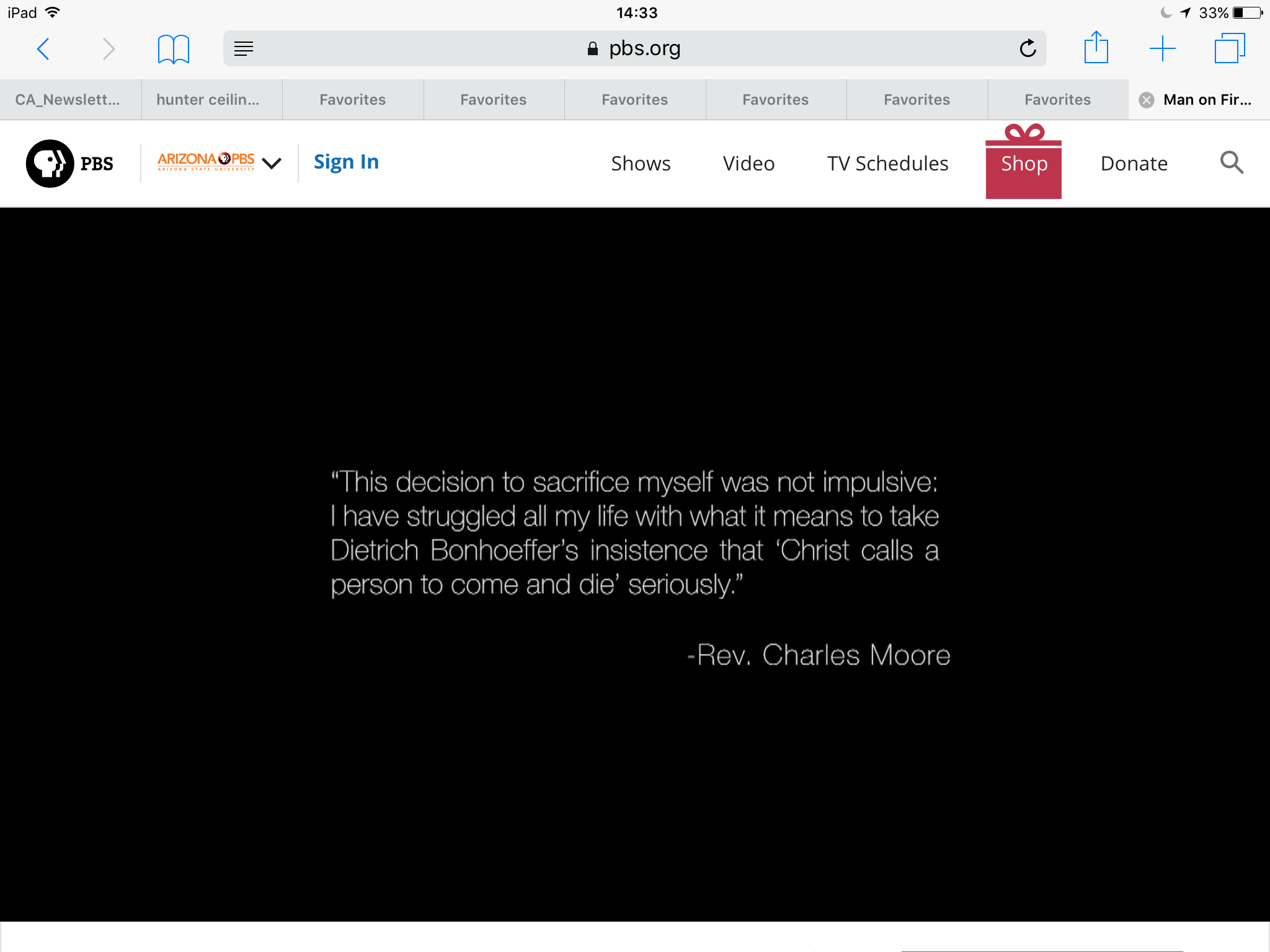
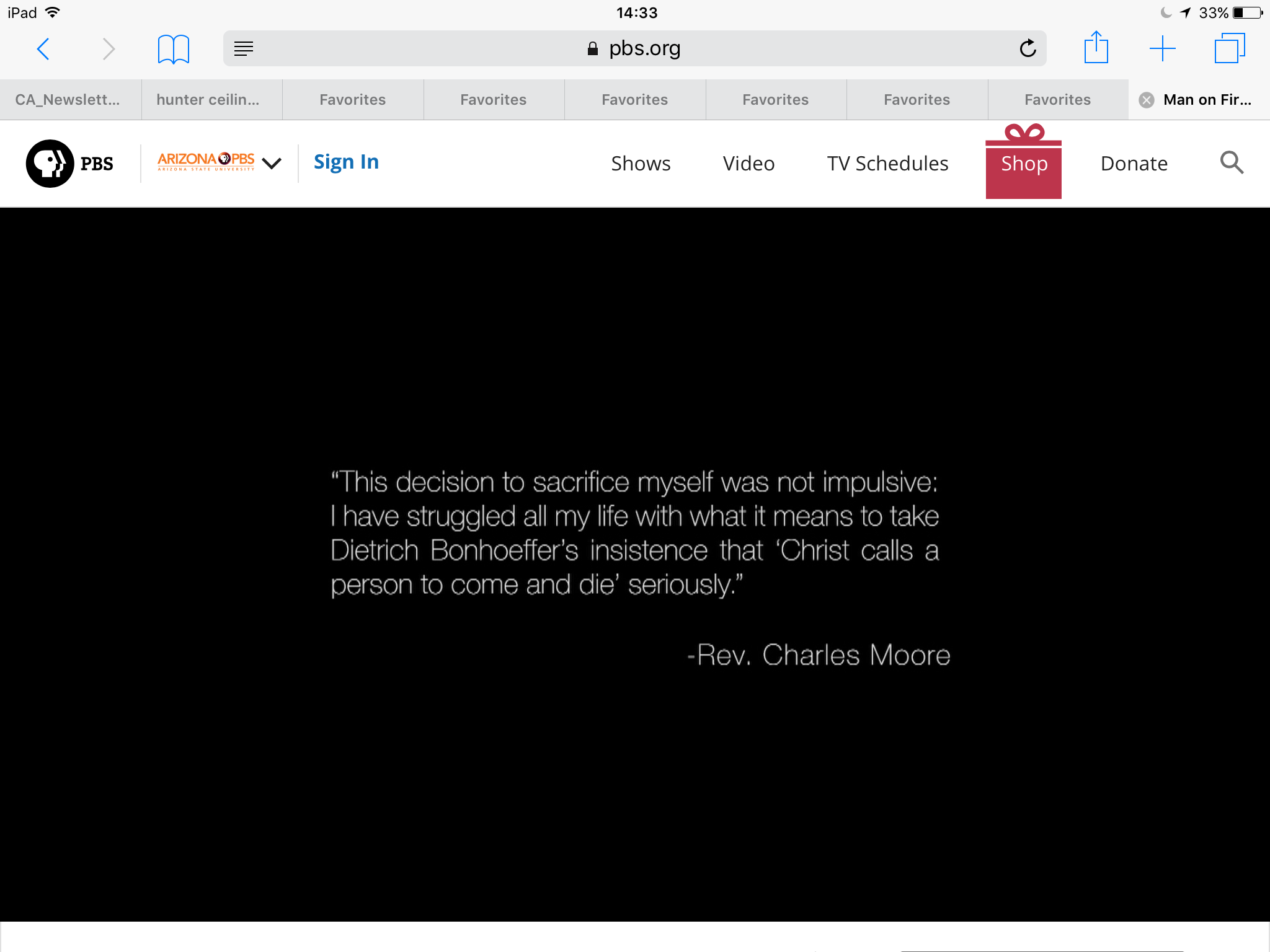
The comment about Bonhoeffer at the beginning, the red gas can, the close up where he poured the gasoline over his head, Guy's comments about his father Jim Wiegel 401 North Beverly Way, Tolleson, Arizona 85353 Tel. 011-623-936-8671 or 011-623-363-3277 jfwiegel@yahoo.com www.partnersinparticipation.com When a great ship is in harbor and moored, it is safe, there can be no doubt. "But that is not what great ships are built for." Clarissa Pinkola Estes
On Dec 21, 2018, at 14:32, Jann McGuire via OE <oe@lists.wedgeblade.net> wrote:
The scenes that stay with me are in the store in Grand Saline where the four men in front play dominos and the owner collects hats and pictures of deceased towns men on a shelf in the back. I have a lot more to say, but will honor the art form method.
Jann McGuire
On Fri, Dec 21, 2018 at 11:50 AM Margaret Aiseayew via OE <oe@lists.wedgeblade.net> wrote: Several scenes deeply impacted me. I was blown away by what seemed to be obvious still existent racism in the newspaper editor and the chamber of commerce sort of representative. It was as if you could see their blinders thickening as they declared their justifications. There were many more. The last scenes of the pep rally tore me apart. Seeing the fire so clearly as the flag bearers were twirling. It felt so lonely, to feel like the only person behind the flag seeing through.
Margaret
From: OE [.wedgeblade.net] On Behalf Of W. J. via OE Sent: Friday, December 21, 2018 8:42 AM To: Order Ecumenical Community Cc: W. J. Subject: [Oe List ...] Man on Fire
Obviously, it's the 'wrong' time of year, when PBS could slip in something totally 'out of character' with the holiday season without much fanfare or public response.
But for those of us who knew and respected Charles as a colleague and friend, this film was hard to miss. And very hard to see. At least for me.
I am struck by the absence of any reference to the film here, let alone commentary.
So let's have a movie conversation!
Starting with, "What scene in the film stayed with you?"
Your turn, folks.
And on top of this tragedy, try to have a very Merry Christmas! If you can. With a long government shutdown about to happen.
Too bad we can't shut down Mr. Trump and his Twitter feed.
Marshall
You can view 'Man on Fire' here for free on-line through January 1:
Man on Fire | Independent Lens
Herewith, in case you missed it, is the
DIRECTOR’S STATEMENT On one level, “Man on Fire” is an investigation into the human spirit. As Charles Moore said in his “suicide” letter, “Our human race is impressed most of all with innocent suffering, and is moved significantly by little else. It isn’t important that I be remembered, but that someone cared enough to give up everything for the sake of others.” These words hold truth for us as a society, yet I, and others, question why someone chose this extreme measure to get our attention. I believe everyone has a piece of Moore in them, whether they are aware of it or not. This yearning to do more, to help others, to sacrifice for the larger good, compels our humanity. So when someone like Moore comes around, at least on the surface, we find ourselves awestruck, riddled with contradicting emotions. On one hand, we see the goodness in Moore, the love of humanity that compelled his actions; yet, on the other hand, the pain of his death overwhelms us too. This complexity was compounded with questions that others were asking in and around Grand Saline: Why did he do it? Is racism still in Grand Saline? Did he actually change anything? These questions were the seeds we planted, and through the process of filming, nurtured, in order to give some semblance of resolve for such an extreme act. Unfortunately (but also quite naturally), the answers to these questions are not so “black and white.” Thus, I hope this film inspires others to also ask these questions and sparks a real conversation on Moore’s death and the reality of racism. Inevitably, some people will write off Moore as crazy, using facts such as “we got a black president” (a quote from the film) to claim that racism doesn‘t exist anymore. However, I believe the answers are more complicated than that. “Man on Fire” uses Moore’s self-immolation as a vehicle to explore this small, mostly white town known for its racism. Moore’s death thus becomes the means to scratch beneath the surface of Grand Saline. The film captures the reality of small town Texas, illustrating Friday night football games, rodeos, homecoming parades, skating rinks, flea market sales, local businesses, and more. Nonetheless, the town of Grand Saline is just a microcosm for the rural south and inevitably America as a whole.
Joel Fendelman, Director of “Man on Fire” Links in the message (1)
Man on Fire | Independent Lens
_______________________________________________ OE mailing list OE@lists.wedgeblade.net http://lists.wedgeblade.net/listinfo.cgi/oe-wedgeblade.net
OE mailing list OE@lists.wedgeblade.net http://lists.wedgeblade.net/listinfo.cgi/oe-wedgeblade.net

I grew up in East Texas, and just 6 years ago lived on a little lake outside Mineola, just up the road from Grand Saline. I drove directly past the spot where Charles did this every time I would go to or from DFW airport. I think the depiction of Grand Saline was mostly accurate and typical of many East Texas towns. The thing about the video that stays in my mind is, I don't recall a single scene where black folks and white folks were together. The schools are integrated, but in most of the small towns like Grand Saline, there are no African Americans in the local population. My guess is that most of the local people who were interviewed in the movie had never been too far from East Texas. Randy On Fri, Dec 21, 2018 at 3:40 PM James Wiegel via OE <oe@lists.wedgeblade.net> wrote:
The comment about Bonhoeffer at the beginning, the red gas can, the close up where he poured the gasoline over his head, Guy's comments about his father[image: image1.PNG]
Jim Wiegel 401 North Beverly Way, Tolleson, Arizona 85353 Tel. 011-623-936-8671 or 011-623-363-3277 jfwiegel@yahoo.com <marilyn.oyler@gmail.com> www.partnersinparticipation.com
When a great ship is in harbor and moored, it is safe, there can be no doubt. "But that is not what great ships are built for." Clarissa Pinkola Estes
On Dec 21, 2018, at 14:32, Jann McGuire via OE <oe@lists.wedgeblade.net> wrote:
The scenes that stay with me are in the store in Grand Saline where the four men in front play dominos and the owner collects hats and pictures of deceased towns men on a shelf in the back. I have a lot more to say, but will honor the art form method.
Jann McGuire
On Fri, Dec 21, 2018 at 11:50 AM Margaret Aiseayew via OE < oe@lists.wedgeblade.net> wrote:
Several scenes deeply impacted me. I was blown away by what seemed to be obvious still existent racism in the newspaper editor and the chamber of commerce sort of representative. It was as if you could see their blinders thickening as they declared their justifications. There were many more. The last scenes of the pep rally tore me apart. Seeing the fire so clearly as the flag bearers were twirling. It felt so lonely, to feel like the only person behind the flag seeing through.
Margaret
*From:* OE [.wedgeblade.net] *On Behalf Of *W. J. via OE *Sent:* Friday, December 21, 2018 8:42 AM *To:* Order Ecumenical Community *Cc:* W. J. *Subject:* [Oe List ...] Man on Fire
Obviously, it's the 'wrong' time of year, when PBS could slip in something totally 'out of character' with the holiday season without much fanfare or public response.
But for those of us who knew and respected Charles as a colleague and friend, this film was hard to miss. And very hard to see. At least for me.
I am struck by the absence of any reference to the film here, let alone commentary.
So let's have a movie conversation!
Starting with, "What scene in the film stayed with you?"
Your turn, folks.
And on top of this tragedy, try to have a very Merry Christmas! If you can. With a long government shutdown about to happen.
Too bad we can't shut down Mr. Trump and his Twitter feed.
Marshall
You can view 'Man on Fire' here for free on-line through January 1:
Man on Fire | Independent Lens <https://www.pbs.org/video/man-on-fire-exakee/>
Herewith, in case you missed it, is the DIRECTOR’S STATEMENT
On one level, “Man on Fire” is an investigation into the human spirit. As Charles Moore said in his “suicide” letter, “Our human race is impressed most of all with innocent suffering, and is moved significantly by little else. It isn’t important that I be remembered, but that someone cared enough to give up everything for the sake of others.” These words hold truth for us as a society, yet I, and others, question why someone chose this extreme measure to get our attention. I believe everyone has a piece of Moore in them, whether they are aware of it or not. This yearning to do more, to help others, to sacrifice for the larger good, compels our humanity. So when someone like Moore comes around, at least on the surface, we find ourselves awestruck, riddled with contradicting emotions. On one hand, we see the goodness in Moore, the love of humanity that compelled his actions; yet, on the other hand, the pain of his death overwhelms us too. This complexity was compounded with questions that others were asking in and around Grand Saline: Why did he do it? Is racism still in Grand Saline? Did he actually change anything? These questions were the seeds we planted, and through the process of filming, nurtured, in order to give some semblance of resolve for such an extreme act. Unfortunately (but also quite naturally), the answers to these questions are not so “black and white.” Thus, I hope this film inspires others to also ask these questions and sparks a real conversation on Moore’s death and the reality of racism. Inevitably, some people will write off Moore as crazy, using facts such as “we got a black president” (a quote from the film) to claim that racism doesn‘t exist anymore. However, I believe the answers are more complicated than that. “Man on Fire” uses Moore’s self-immolation as a vehicle to explore this small, mostly white town known for its racism. Moore’s death thus becomes the means to scratch beneath the surface of Grand Saline. The film captures the reality of small town Texas, illustrating Friday night football games, rodeos, homecoming parades, skating rinks, flea market sales, local businesses, and more. Nonetheless, the town of Grand Saline is just a microcosm for the rural south and inevitably America as a whole.
Joel Fendelman, Director of “Man on Fire” Links in the message (1)
Man on Fire | Independent Lens
_______________________________________________ OE mailing list OE@lists.wedgeblade.net http://lists.wedgeblade.net/listinfo.cgi/oe-wedgeblade.net
_______________________________________________ OE mailing list OE@lists.wedgeblade.net http://lists.wedgeblade.net/listinfo.cgi/oe-wedgeblade.net
_______________________________________________ OE mailing list OE@lists.wedgeblade.net http://lists.wedgeblade.net/listinfo.cgi/oe-wedgeblade.net
-- *"Anything else you're interested in is not going to happen if you can't breathe the air and drink the water. Don't sit this one out. Do something."* *--Carl Sagan*

Thank-you Randy. With love and admiration, remembering all fine my times with Charles. Never knowing, ever acting, Ken On Dec 21, 2018, at 4:58 PM, Randy Williams via OE <oe@lists.wedgeblade.net> wrote: I grew up in East Texas, and just 6 years ago lived on a little lake outside Mineola, just up the road from Grand Saline. I drove directly past the spot where Charles did this every time I would go to or from DFW airport. I think the depiction of Grand Saline was mostly accurate and typical of many East Texas towns. The thing about the video that stays in my mind is, I don't recall a single scene where black folks and white folks were together. The schools are integrated, but in most of the small towns like Grand Saline, there are no African Americans in the local population. My guess is that most of the local people who were interviewed in the movie had never been too far from East Texas. Randy On Fri, Dec 21, 2018 at 3:40 PM James Wiegel via OE <oe@lists.wedgeblade.net <mailto:oe@lists.wedgeblade.net>> wrote: The comment about Bonhoeffer at the beginning, the red gas can, the close up where he poured the gasoline over his head, Guy's comments about his father<image1.PNG> Jim Wiegel 401 North Beverly Way, Tolleson, Arizona 85353 <> Tel. 011-623-936-8671 <tel:011-623-936-8671> or 011-623-363-3277 <tel:011-623-363-3277> jfwiegel@yahoo.com <mailto:marilyn.oyler@gmail.com> www.partnersinparticipation.com <http://www.partnersinparticipation.com/> When a great ship is in harbor and moored, it is safe, there can be no doubt. "But that is not what great ships are built for." Clarissa Pinkola Estes On Dec 21, 2018, at 14:32, Jann McGuire via OE <oe@lists.wedgeblade.net <mailto:oe@lists.wedgeblade.net>> wrote:
The scenes that stay with me are in the store in Grand Saline where the four men in front play dominos and the owner collects hats and pictures of deceased towns men on a shelf in the back. I have a lot more to say, but will honor the art form method.
Jann McGuire
On Fri, Dec 21, 2018 at 11:50 AM Margaret Aiseayew via OE <oe@lists.wedgeblade.net <mailto:oe@lists.wedgeblade.net>> wrote: Several scenes deeply impacted me. I was blown away by what seemed to be obvious still existent racism in the newspaper editor and the chamber of commerce sort of representative. It was as if you could see their blinders thickening as they declared their justifications. There were many more. The last scenes of the pep rally tore me apart. Seeing the fire so clearly as the flag bearers were twirling. It felt so lonely, to feel like the only person behind the flag seeing through.
Margaret
From: OE [.wedgeblade.net <http://wedgeblade.net/>] On Behalf Of W. J. via OE Sent: Friday, December 21, 2018 8:42 AM To: Order Ecumenical Community Cc: W. J. Subject: [Oe List ...] Man on Fire
Obviously, it's the 'wrong' time of year, when PBS could slip in something totally 'out of character' with the holiday season without much fanfare or public response.
But for those of us who knew and respected Charles as a colleague and friend, this film was hard to miss. And very hard to see. At least for me.
I am struck by the absence of any reference to the film here, let alone commentary.
So let's have a movie conversation!
Starting with, "What scene in the film stayed with you?"
Your turn, folks.
And on top of this tragedy, try to have a very Merry Christmas! If you can. With a long government shutdown about to happen.
Too bad we can't shut down Mr. Trump and his Twitter feed.
Marshall
You can view 'Man on Fire' here for free on-line through January 1:
Man on Fire | Independent Lens <https://www.pbs.org/video/man-on-fire-exakee/> Herewith, in case you missed it, is the
DIRECTOR’S STATEMENT On one level, “Man on Fire” is an investigation into the human spirit. As Charles Moore said in his “suicide” letter, “Our human race is impressed most of all with innocent suffering, and is moved significantly by little else. It isn’t important that I be remembered, but that someone cared enough to give up everything for the sake of others.” These words hold truth for us as a society, yet I, and others, question why someone chose this extreme measure to get our attention. I believe everyone has a piece of Moore in them, whether they are aware of it or not. This yearning to do more, to help others, to sacrifice for the larger good, compels our humanity. So when someone like Moore comes around, at least on the surface, we find ourselves awestruck, riddled with contradicting emotions. On one hand, we see the goodness in Moore, the love of humanity that compelled his actions; yet, on the other hand, the pain of his death overwhelms us too. This complexity was compounded with questions that others were asking in and around Grand Saline: Why did he do it? Is racism still in Grand Saline? Did he actually change anything? These questions were the seeds we planted, and through the process of filming, nurtured, in order to give some semblance of resolve for such an extreme act. Unfortunately (but also quite naturally), the answers to these questions are not so “black and white.” Thus, I hope this film inspires others to also ask these questions and sparks a real conversation on Moore’s death and the reality of racism. Inevitably, some people will write off Moore as crazy, using facts such as “we got a black president” (a quote from the film) to claim that racism doesn‘t exist anymore. However, I believe the answers are more complicated than that. “Man on Fire” uses Moore’s self-immolation as a vehicle to explore this small, mostly white town known for its racism. Moore’s death thus becomes the means to scratch beneath the surface of Grand Saline. The film captures the reality of small town Texas, illustrating Friday night football games, rodeos, homecoming parades, skating rinks, flea market sales, local businesses, and more. Nonetheless, the town of Grand Saline is just a microcosm for the rural south and inevitably America as a whole.
Joel Fendelman, Director of “Man on Fire” Links in the message (1)
Man on Fire | Independent Lens
_______________________________________________ OE mailing list OE@lists.wedgeblade.net <mailto:OE@lists.wedgeblade.net> http://lists.wedgeblade.net/listinfo.cgi/oe-wedgeblade.net <http://lists.wedgeblade.net/listinfo.cgi/oe-wedgeblade.net> _______________________________________________ OE mailing list OE@lists.wedgeblade.net <mailto:OE@lists.wedgeblade.net> http://lists.wedgeblade.net/listinfo.cgi/oe-wedgeblade.net <http://lists.wedgeblade.net/listinfo.cgi/oe-wedgeblade.net>
OE mailing list OE@lists.wedgeblade.net <mailto:OE@lists.wedgeblade.net> http://lists.wedgeblade.net/listinfo.cgi/oe-wedgeblade.net <http://lists.wedgeblade.net/listinfo.cgi/oe-wedgeblade.net> -- "Anything else you're interested in is not going to happen if you can't breathe the air and drink the water. Don't sit this one out. Do something." --Carl Sagan _______________________________________________ OE mailing list OE@lists.wedgeblade.net http://lists.wedgeblade.net/listinfo.cgi/oe-wedgeblade.net
participants (7)
-
 H. A. Tillinghast
 -
 James Wiegel
 -
 Jann McGuire
 -
 Ken Fisher
 -
 Margaret Aiseayew
 -
 Randy Williams
 -
 W. J.
W. J.