Here is a few paragraphs on Imaginal Education from 1965. This
excerpt is taken from IMAGE JOURNAL
OF THE ECUMENICAL INSTITUTE Division of the
Church Federation of Greater Chicago NUMBER THREE, WINTER,
1965 EDUCATING THE
IMAGINATION OF MODERN YOUTH
The full text is available on line
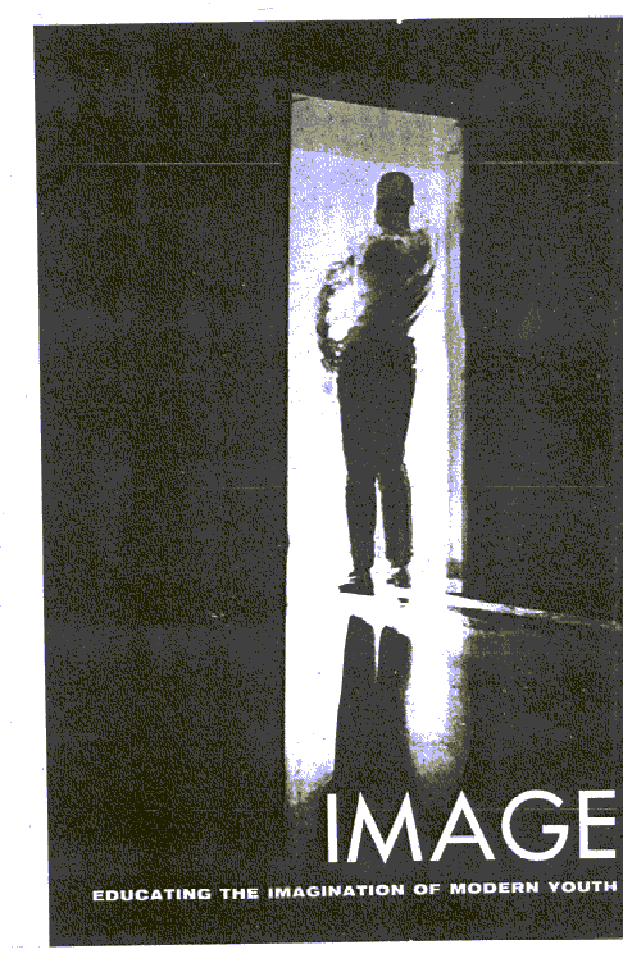
Imaginal Education
THE HUMAN ENTERPRISE of
education is the keystone in the civilizing adventure. Social explosions
vitally effect the educational foundations of a people. Since World War II and
especially since Sputnik I, education in America has received a privileged
priority in public attention so that now it has become one of our largest social
activities. These very circumstances, however, constitute a temptation to think
of our educational task simply in quantitative terms. Certainly our present
efforts must be vastly expanded in a variety of directions. But this must not
blind us to a qualitative defect in our educational processes. If our previous
analysis is correct, the world of youth demands that we now recognize another
dimension of education relatively unnoticed hitherto. This is the existing gap
between formal learning and the ability of the student to relate our cultural
knowledge to a significant and creative existence in the postmodern world. Our
youth suffer deeply from this lack in the education of the imagination. Herein
is the crucial challenge to present day society which is disclosed by the youth
culture emerging from the moral crisis occasioned by the current cultural
revolutions.
The human imagination is
involved in all forms of thinking and learning. The term imaginal education
is used here in the special way that has already been implied. It aims at
enabling the student to discover and create images of himself in his real world
which will motivate him to free, intelligent, responsible involvement in
civilization. Images are the bridges between abstract ideas and the specific
deed. They both illuminate the practical situation and impel to concrete
action. Images offer the deep, personal permission to be and to do. They are
the guides, forces and critics of our sense of personal integrity and
vocational accomplishment. In sum, imaginal education intends to awaken, expand
and furbish the imagemaking capacity in man and thereby to release him into
effective participation in society.
This must not be seen
mistakenly as an exclusive problem of the individual. It is a major social
issue of far-reaching consequences. A nation, a city, must decide whether it
can afford to have a citizenry ill-equipped to engage creatively in the social
task of building new structures for human existence and social wellbeing. This
is not to mention the social cripples who are a direct liability to society,
not in the first instance because they have been subject to subnormal
environment, childhood warping or innate weakness of will, but because they
have inadequate self-pictures and fail to organize their personal and social
experiences significantly.
If this insistence is
correct, it is obvious that a decision must be made as to whether or not the
formal educational system should be responsible for imaginal education. If the
answer is yes, radical changes in curricula, pedagogy and organizational form
must follow. And it is not only the formal and public aspects of society's
educational endeavor that are called to account by the demand for images.
Various kinds of social agencies, character building institutions, independent
welfare societies, religious bodies and private schools all have a
responsibility for the educational task and all must face this need for
relevant and effective means of educating the imagination of postmodern man.
Since no simple, self-evident answers are at hand, a variety of novel
experimental ventures must be created and fostered.
What is needed is a
reconstruction of life attitudes, a reeducation of the imagination. Whatever
this process be called-motivational, contextual, attitudinal or imaginal
education-a new dimension must be added to our concept of learning.
It is true that no era
has equaled our own in concern for equipping the rising generation
quantitatively and in quality for its responsibility in civilization. Almost
frantic efforts are being made to cope with the number to be educated and the
kinds of education to give them-vocational training, remedial instruction,
social readjustment and prekindergarten schooling. But educators almost
unanimously report a common frustration. There is a quality in the learning
process which is missing. More and better buildings, more and better
counseling, more and better facilities and more and better teachers do not
answer the desperate need for young people to become full persons, total human
beings responsible for society's welfare. Full and constructive participation
in civilization requires that the individual understand his significance and
his place in life. It requires that his mental image of himself be one of worth
in his humanness with all its strengths and weaknesses. A society cannot long endure
without its people appreciating their genuine humanness as a gift to bestow
upon it.
Education which does not
take this vital factor into account, which does not provide its students with
such an essential self-understanding, is in danger of producing agents
motivated by self-interest only. Such will not become a fruit of progress but
a thorn in its side. This could well be the most crucial issue of our time.
THE
FUNDAMENTAL NEED of postmodern youth is for self images relevant to the actual
world in which he lives and adequate to organize meaningfully his personal and
communal experience so that he can appropriate a sense of significance in
involving himself in the human drama of civilization. Such has been the
contention of the previous essays. In short, it is the need for imaginal
education
Jim Wiegel
Never trust atoms. They make up everything. a billboard
401 North Beverly Way,Tolleson, Arizona 85353
Never trust atoms. They make up everything. a billboard
401 North Beverly Way,Tolleson, Arizona 85353
011-623-936-8671 or 011-623-363-3277
Upcoming public course opportunities:
ToP® Facilitation Methods: Sep 9-10, Nov 18-19, 2014 Click to watch video.
ToP® Strategic Planning: Oct 7-8, 2014 Click to learn more.
Facilitation Mastery: The Mastering the Technology of Participation program begins in Oakland on Nov 12-14, 2014 Click to watch video.
For online registration go to http://www.top-training.net
The AZ ToP® Community of Practice meets the 1st Friday, 1-4 pm, starting again on Sept 5th at ACYR, 648 N. 5th Avenue, Phoenix, AZ 85003
AICP Planners: 14.5 CM for all ToP® courses
From: Marianna Bailey via Dialogue <dialogue@lists.wedgeblade.net>
To: Jack Gilles <jackcgilles@gmail.com>
Cc: "Dialogue@wedgeblade.net" <Dialogue@wedgeblade.net>; Tim Dove <DovePHX@gmail.com>; "OE@wedgeblade.net" <OE@wedgeblade.net>; Burna Dunn <bldunn1@gmail.com>; "oslotta@earthlink.com" <oslotta@earthlink.com>
Sent: Monday, December 8, 2014 5:50 PM
Subject: Re: [Dialogue] [Oe List ...] Fwd: Question about Imaginal Education these days
I would like to hear from Kaze Gadway, Sarah Buss and Nan Grow. They were there when the rational objective and existential aim was created using the comprehensive triangle on education.
Marianna
On Dec 7, 2014, at 12:10 PM, Jack Gilles via Dialogue wrote:
Dear All,
_______________________________________________I think Jeanette has done the best job of answering the question of a definition. But we have to understand that “we” have a long history of this definition and tend to assume that others grasp the profound depth behind it, and I don’t think they do. For instance, although the term ORID is based on a natural flow of consciousness, to utilize it effectively requires a depth understanding of I.E. and that in and by itself is not Imaginal Education (as we define the term). The same for Project Work, Strategic Planning and other methods we have honed and championed.
It could be said that all “education” is “Imaginal”, that is, it is based on a set of images and assumptions that are then communicated in a method called Education. And it is more than just being “conscious” about the process. Those who want to teach about American Exceptional-ism are very clear that they want certain “images” to be communicated and to take root. Thus you have a spectrum of Imaginal Education from outright designed propaganda to unconscious and unquestioned “Images” that are the basis of what is being communicated.
So the issue of I.E. is the life stance and understanding that is underneath the process. To use our language, the “Word” is absolutely essential for the process. That reality is worthy of a long” discourse, but to be an effective Imaginal Educator it needs to be understood at the heart of the creative effort. For people’s information, Mark Dove’s son, Tim, has done a fantastic job of just that, without ever mentioning any of our historic language. So, having a profound and self-conscious understanding of humanness is essential for effective Imaginal Education as we have framed it.
Good discussion (dialogue)!
Jack
P.S. I’ve added Tim Dove’s name to the list so that he can see how this discussion is going and can respond if he so desires. He is the best example of anyone I know who has built a whole-system understanding of education based on Imaginal Education.
On Dec 7, 2014, at 10:23 AM, Jeanette Stanfield via OE <oe@lists.wedgeblade.net> wrote:For me, imaginal education is an art. It is the discernment of images that are blocking a person, a group, a community, or society from moving positively into the future. Once discerned, messages are powerfully and creatively put into the learning environment through questions, stories, art forms, projects, activities,models etc to release the negative images and allow new images to emerge and thus new decisions and behaviours.Thank you Steve and Loren for inviting this conversation.Jeanette_______________________________________________On Sun, Dec 7, 2014 at 10:22 AM, Randy Williams via Dialogue <dialogue@lists.wedgeblade.net> wrote:I would say that the goal of imaginal education is to change behavior. Our outmoded, out of date stories of reality (images) are at the root of all our problems. Example of an outmoded story--we can have unlimited economic growth on a finite planet--the story underlying climate change, global warming, and all the associated symptoms.Randy
Sent from my iPadImaginal Education acknowledges that images affect behavior and that images can change. The goal of the Imaginal Educator is to change images by using a variety of teaching methods, one of which is the structured conversation model, called ORID. The goal of Imaginal Educators trained by the ICA has been to change a victim image to an image of one's individual power to affect one's life and the world.from Karen Bueno-----Original Message-----
From: steve har via Dialogue <dialogue@lists.wedgeblade.net>
To: Order Ecumenical ICA-USA <dialogue@lists.wedgeblade.net>; oe <oe@lists.wedgeblade.net>; Tatwa P. Timsina <tatwa@ica-nepal.org>
Sent: Sun, Dec 7, 2014 7:32 am
Subject: [Dialogue] Question about Imaginal Education 9these daysIn Nepal and India Nelson Stover and Loren Weybright are collaborating on two schools one in Nepal and one in Chikhale school in Maharastra. Loren is onsite in Nepal for 3 months doing Action Plan projects with the staff & teachers and curriculum design and coaching with individual teachers. In January they both will be in Maharastra at the Chickhale school for a 2 day professional development. Here is a question that needs an answer: Just what is Imaginal Education, Now and how do you practice it? Nelson asked this question and they are looking for a variety of (simple) responses. Can you share a sentence on Imaginal Education rom your experience, short, simple? -- Steve Harrington PS if you want you can track developments in Nepal and Chikhale by signing up at the Imaginal Education Collection upper right hand corner here: https://wedgeblade.net/wordpress/imaginaleducation/blog/ _______________________________________________ Dialogue mailing list Dialogue@lists.wedgeblade.net http://lists.wedgeblade.net/listinfo.cgi/dialogue-wedgeblade.net_______________________________________________
OE mailing list
OE@lists.wedgeblade.net
http://lists.wedgeblade.net/listinfo.cgi/oe-wedgeblade.net
_______________________________________________
Dialogue mailing list
Dialogue@lists.wedgeblade.net
http://lists.wedgeblade.net/listinfo.cgi/dialogue-wedgeblade.net
OE mailing list
OE@lists.wedgeblade.net
http://lists.wedgeblade.net/listinfo.cgi/oe-wedgeblade.net
Dialogue mailing list
Dialogue@lists.wedgeblade.net
http://lists.wedgeblade.net/listinfo.cgi/dialogue-wedgeblade.net
_______________________________________________
Dialogue mailing list
Dialogue@lists.wedgeblade.net
http://lists.wedgeblade.net/listinfo.cgi/dialogue-wedgeblade.net
Dialogue mailing list
Dialogue@lists.wedgeblade.net
http://lists.wedgeblade.net/listinfo.cgi/dialogue-wedgeblade.net