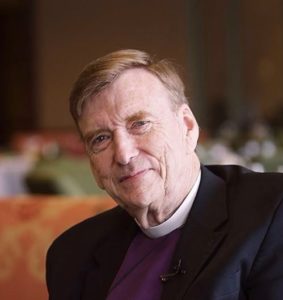
David Felten:
It seems to me that one of the most persistent “proofs” people use to add credibility to their beliefs is the notion that God has personally communicated certain “truths” to human beings through some sort of direct – but external — revelation.
Michael Morwood: Yes, since the beginning, Christians have been expected to embrace a picture of reality that imagines an external deity who, although disconnected from humanity, manages to manipulate people and circumstances to further his own devices. God “chose” the Hebrew people to be his “chosen people” to fulfill his plans on earth. But when they failed, God sent his son from heaven to reveal God to us and to open the way to heaven for us.
For many Christians, an essential aspect of the revelatory process is the idea that God himself chose particular people to reveal his thinking and his opinions on a wide range of topics through “sacred texts” – and almost thirty years after the supposed reforms of Vatican II, the Catechism of the Catholic Church (1992) continued to promote the same fanciful idea:
“To compose the sacred books, God chose certain men who, all the while he employed them in this task, made full use of their own faculties and powers so that, though he acted in them and by them, it was as true authors that they consigned to writing whatever he wanted written, and no more.” (#106)
The only way that image of reality has any credibility is when we are locked into imagining a distant male deity intervening from the heavens.
Felten: Then how is wisdom or insight conveyed to humanity in this new template for religion?
Morwood: If we believe that what we’re dealing with today is a mystery present and operative throughout the whole universe, then our understanding of “revelation” and “inspiration” changes quite dramatically — and has monumental consequences.
Rather than coming from elsewhere, the revelation of the great mystery we are dealing with comes from the ground up, from what is all around us. The great mystery we are trying to comprehend is embedded in everything that exists. Everything that exists gives expression to it.
Felten: So we move from our fixation on the peoples, texts, and stories of, say, the last 3,000 years, to a perspective that embraces the whole of creation?
Morwood: Just think about it: on this small planet in a cosmic nowhere, this mystery has been given earthly expression for
four-and-a-half billion years — and we can marvel at what is possible when the conditions are just right: life in abundance.
Felten: And the human species is a product of this abundance of life.
Morwood: Yes! And in telling the contemporary story of the emergence of the human species, the significant theological shift is to move from imagining an external deity directing that emergence to taking seriously and imagining this creative, energizing, mysterious reality being embedded within human beings – just as it is in everything that exists.
The big mistake in theological thinking has been to misplace the grounding of reality in the heavens in the form of gods. Then human “middle-management” needed to be developed to deal with the gods.
Case in point is the Hebrew people developing the notion of one almighty deity. This was a time when people thought gods ruled the world from above. So within this framework, they developed the most inspiring religious understanding of themselves they could imagine: a people selected by this God to create “God’s rule” on earth. This vision embodied their highest aspirations, a society characterized by justice, compassion and peace.
However, along with the development of their structured, institutional religion came the distractions of power, political influence, wealth, and straying from the goals set before them.
So prophetic voices of great wisdom and insight were raised to keep this religion on track.
Inevitably, these voices were couched in the religious thinking of the times. God was perceived to be a heavenly deity who intervened in human affairs and made his thoughts known through human messengers. So, the insights of many a wise human being is therefore attributed to “God” and we end up reading and hearing: “This is what the Lord God says…” “This is that God wants…”.
Felten: And this is another element of what you referred to earlier as the “floppy disc version”?
Morwood: Yes, and if we’re to make sense of this great wisdom and insight in the 21st century, what we need is a whole new operating system. These ancient insights and wisdom are real and not to be cast aside. But they need to be understood and appreciated as being a by-product of this mystery embedded in human speakers and writers,
not coming from outside or coming down to them from “heaven.”
This mystery, this source of this wisdom – call it “GOD” if you wish – is embedded
in humans.
While Amos and Hosea and Isaiah and Ruth and Naomi were giving expression to this great mystery in human words and actions, the same was happening all around the world in all peoples, in all cultures, and in all places. Men and women gave human expression the best they could to this presence and power and mystery within them.
While Jeremiah was speaking and acting and allowing this embedded reality to have its way in and through him, the same phenomenon was happening in the aboriginal people who lived throughout what is now Australia. Revelation is no longer a matter of one people hearing and giving human expression to this “GOD” reality. It is a matter of acknowledging this reality everywhere, in all people, at all times, and putting an end to exclusive institutional or cultural claims to access this mystery.
Felten: You mentioned earlier that changes to our understanding of “revelation” and “inspiration” would have monumental consequences. Can you elaborate?
Morwood: Briefly, here are just four consequences:
First, most Christians are familiar with the response to Scripture readings, “This is the Word of the Lord.” Going forward, this “Word of the Lord” language has to be explicitly understood as metaphor or figurative language – and as such has to be expanded to include all human wisdom.
Secondly, let’s pull Paul back somewhat. He was a first century Jewish theologian. Let’s treat his writings in the same way we would explore the writings of any theologian of any religion. The writings of Paul have to lose their mystique as the never-to-be-questioned “Word of the Lord.” In other words, stop trying to end all discussion about the resurrection, about “the Christ”, about the end times, about the sending of God’s Spirit from heaven, about God’s eternal plan of salvation, about justification, about God’s wrath, and about salvation with proof-texting from Paul
Three. I believe the “Christ” religion – in its many official formats – is generally more concerned with defending ideas that protect and preserve its institutional identity than it is with open and honest theological thinking. It closes its thinking to new understandings of revelation because new understandings may call into question its institutional identity claims – claims that depend on the understanding that God is disconnected from humanity and the connection can only be restored through one particular interpretation of “Christ.”
So, for number four, I believe that the day is over when a religion can put revelation in a box and say, “No more.”
Felten: So being aware of the “everywhere” nature of revelation opens up the possibility that everything is cause for wonder – even the pedestrian task of being human.
Morwood: Today we can tell the story of our beginnings in a wonderfully dramatic way, borne out of the explosion of a giant star four-and-a-half billion years ago. From the stardust of that explosion, every atom in our bodies began a long journey, through transformation after transformation, to who and what we are today. There are atoms in our bodies that were once in dinosaurs, carbon atoms that were once in the Buddha, in Jesus, in Constantine.
Going forward, this scientific story will be foundational for religious thinking and imagination for future generations.
Felten: So what does this scientific story say about being human? What does this new template for religion say about the nature of our humanity?
Morwood: We are stardust. We are stardust become human. We are a life-form that gives the universe a way to reflect on itself. Each one of us has the gift of a lifetime to give human expression to whatever drives the universe and the evolutionary process that drives the development of life on earth – but not without some urgency. We only have one chance to do this, just one lifetime.
Hopefully, religious thinking will use and build on the scientific story of our beginnings and come to the inevitable conclusion of, “Wow, there’s another, even more astonishing, dimension to the human story.” To be human is to give human expression to the great mystery that sustains and holds everything in existence. We all give this great mystery – call it “GOD” if you will – a way of coming to human expression.
Felten: Ooooh. I can think of a lot of conventional Christians who would object to this idea. They’d say, “Jesus was the only human expression of God!”
Morwood: OK, so let’s tell an updated story of Jesus, one that reflects the scientific story and an understanding of the world in which we actually live (instead of clinging to the institutional Christology of the creeds). Instead of telling the story about Jesus as if God had disconnected from humanity and withdrawn friendship and forgiveness, and that Jesus alone had “the Spirit of the Lord” within him, and that the Spirit of God was waiting for something momentous to happen on earth before descending onto selected humans, let’s tell a story of this great mystery, of “GOD,” being embedded in all humans.
And since this great mystery is truly in every person, we would expect its presence to be revealed among all people. It would surface in the creativity of gifted men and women the way Mozart gave expression to music. Wasn’t his brilliance an expression of this great mystery in the human species?
Likewise with Jesus and his religious insight. In the language of his religion and time he was able to say, “The Spirit of the Lord is upon me,” as he knew it had been in the prophets before him. Jesus looked around and saw his reality dominated by violence, military power, greed, fear and oppression. With this Spirit in him and knowing that the dream of his religion was to create God’s rule on earth, he must have wondered, “Is this the best we can do?”
Knowing that the ideal behind the Torah was to make people God-conscious in their everyday activities, Jesus must have wondered how he could be so God-conscious and so many people around him were not. How come people couldn’t see and experience what he saw and experienced? How could this dream of “God’s rule or kingdom” be realized in the reality he encountered?
In the long term, the only option with any hope was to go to the populace, the “crowd,” and try to help them become aware of the “Spirit of the Lord” in them. He did this by addressing their fear of God and their sense of distance from God. He wanted to affirm a presence, a power in them. His task was to convince people that there was more to who they were than they realized. He wanted to empower them to take responsibility for making the world a better place.
The way Jesus saw it, there was nothing more urgent than for people to grasp and work with the Spirit already within them. It may be like a small seed, but it had to start somewhere. He was driven by this dream and the task it presented.
I doubt that Jesus ever thought he would see his dream realized in his lifetime. Human experience tells us that it can take decades for significant religious and social change to take place. I think Jesus worked on the “Go home and think about this” principle of educating people as he told parables and gave clear teaching on how God’s rule could be implemented. I think Jesus was looking well ahead to what could be in place when the Roman Empire ended and people began looking for a more satisfying way of life.
Felten: But I can hear well-meaning traditional Christians asking, “What about Jesus suffering and dying to save me from the “wrath to come”?
Morwood: There is nothing in Jesus’ preaching about a God whose forgiveness was conditional on some dramatic human event. There is nothing about a God disconnected from people. There is no concern whatever about saving people from God’s “wrath” or getting to heaven.
There is nothing about Jesus needing to be anointed by God in heaven to become the central figure in a cosmic story about salvation and God directing the universe to its final conclusion with this heavenly “Christ” as the pinnacle of creation.
The Jesus we know in the synoptic gospels focused on
this world, the desperate need for people to work together to make it a better place, and a Way this could be accomplished, despite the world being organized in a way that blocked the “kingdom of God” from being realized. And for attempting to empower people so they might question and challenge the religious, social, and political status quo, he paid the price.
The future for any group that gathers around the Jesus’ story has to return to and focus on these basic issues if its members are, in any true sense, to be called followers of Jesus.
~ Rev. David Felten with Michael Morwood
In the final installment of “A New Template for Religion,” Felten will ask Morwood to apply his three questions to the concepts of worship and prayer.
About Michael Moorwood
With over 40 years’ experience as a sought-after retreat leader and educator, Michael Morwood is well known around the world. Bishop John Shelby Spong writes: “Michael Morwood … is raising the right and obvious questions that all Christians must face. He provides fresh and perceptive possibilities for a modern and relevant faith.” With
a dozen books to his name (
two of which were banned before he resigned from the Catholic priesthood), Morwood brings an extensive background in spirituality to what he sees as the urgent need to reshape Christian thinking for a new millennium.
Be sure to visit Michael Morwood’s website by clicking
HERE
About the Author
David Felten is a full-time pastor at
The Fountains, a United Methodist Church in Fountain Hills, Arizona. David and fellow United Methodist Pastor, Jeff Procter-Murphy, are the creators of the DVD-based discussion series for Progressive Christians,
Living the Questions.
A co-founder of the Arizona Foundation for
Contemporary Theology and also a founding member of
No Longer Silent: Clergy for Justice, David is an outspoken voice for LGBTQ rights both in the church and in the community at large. David is active in the
Desert Southwest Conference of the United Methodist Church and tries to stay connected to his roots as a musician. You’ll find him playing saxophones in a variety of settings, including appearances with the
Fountain Hills Saxophone Quartet.
David and his wife Laura, an administrator for a large Arizona public school district, live in Phoenix with their three often adorable children.
Read the essay online
here.


 What follows in interview form is the second of three columns inspired by a presentation Michael Morwood offered at the