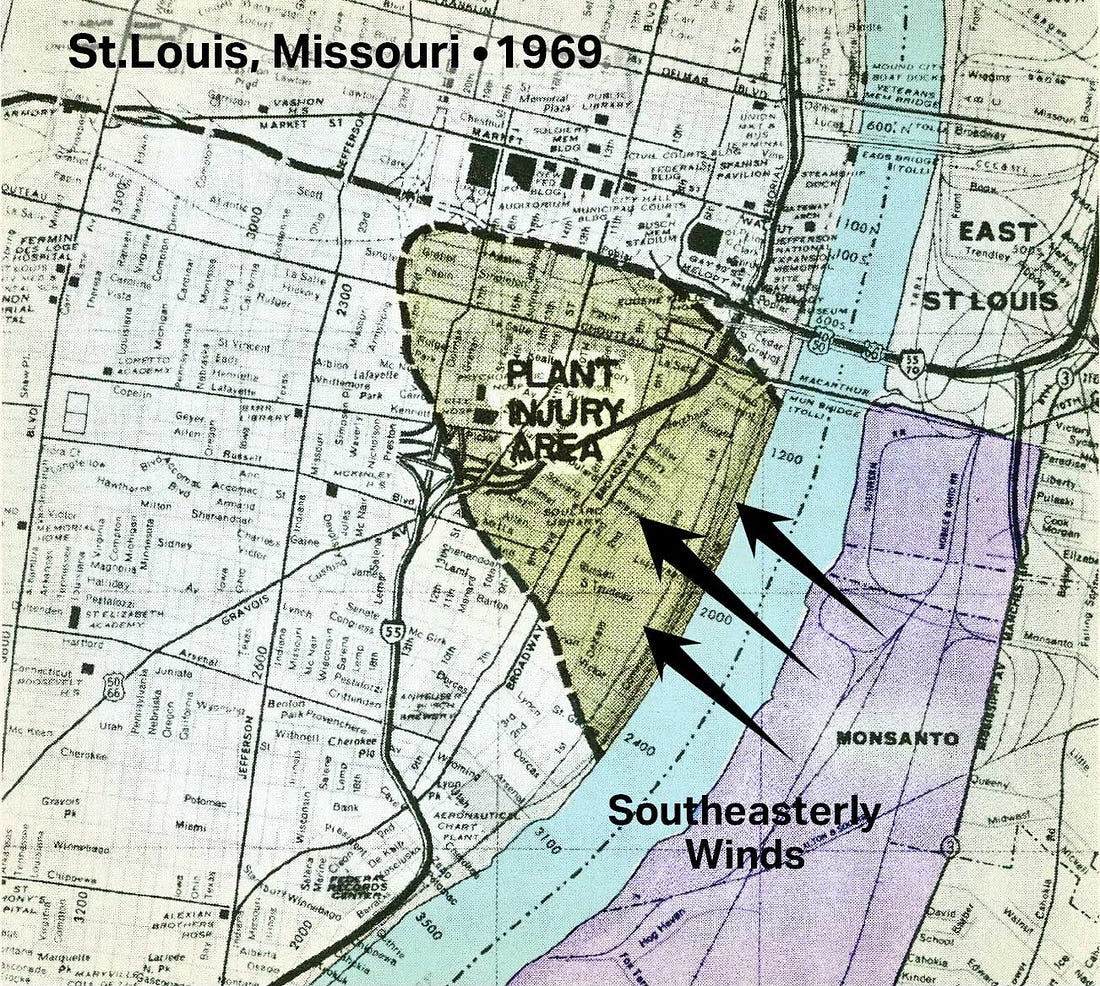
Walking through St. Louis neighborhoods in the spring of 1969, a curious plant scientist noticed something uncanny: whole blocks of plants looked stricken. Leaves curled like closing hands, stems twisted, and redbuds and forsythias seemed frozen mid-grimace. This wasn’t random city stress. It looked directional—like a signal, or a warning.
What startled him most was the ginkgo—a tree with a 200-million-year lineage and a reputation for surviving pollution, pests, and almost anything a city can throw at it—showing clear signs of injury.
The curious scientist was my father, Fred Lanphear. Fred had trained as a horticulturist at Penn State in the 1950s, back when the reigning philosophy was simple: if nature misbehaves or isn’t productive enough, bring out the chemicals. Then Rachel Carson published Silent Spring, and that tidy worldview began to wobble. By the time he took a sabbatical at Washington University in 1968, he was already suspicious of the idea that we could “manage” nature with synthetics and good intentions.
Christian Elliott’s recent essay, Field Reporting in Your Own Backyard, brought me back to the study my father conducted in St. Louis that year. Their stories, told half a century apart, reveal the same unsettling truth: we know far too little—yet more than enough to see that we are failing to protect people from these poisonous plumes.
Fred worked with Oscar Soule to survey the damage and reproduce it in the laboratory. Their study, Injury to City Plants from Industrial Emissions of Herbicides, documented widespread damage from airborne herbicides—mainly 2,4-D and 2,4,5-T. But this wasn’t agricultural drift. It was industrial emissions drifting invisibly into St. Louis neighborhoods.
They mapped the injury across the city, and a pattern emerged: the damage weakened with distance but lined up along a narrow axis. When they overlaid wind patterns, the source snapped into focus—the Monsanto plant on the other side of the Mississippi River. The city’s trees and shrubs had drawn a botanical bullseye around the facility.
They showed that at least seven herbicide byproducts from manufacturing could reproduce the same injuries at concentrations as low as 1 ppm. The isobutyl ester of 2,4-D—especially as a vapor—was the standout culprit. In greenhouse tests, even plants on upper floors above the exposure chamber wilted. The chemicals didn’t need a direct hit; they simply drifted upward, outward, everywhere.
Lanphear and Soule emphasized a point that still feels ahead of its time: plants can be better early-warning systems than machines. Air monitors track familiar pollutants like sulfur dioxide, but substantial hazards from the unmonitored, site-specific chemicals no one thinks to measure could be wreaking havoc. The ecological evidence was unmistakable. The human evidence? Missing.
That’s where the story starts to darken. We still don’t know how long those emissions drifted across St. Louis, how far they traveled, or what the long-term health consequences may have been. Lanphear and Soule cited a study showing that 2,4-D was fetocidal and teratogenic in rats at higher concentrations—evidence that should have prompted studies of preterm birth or birth defects in the affected neighborhoods. But no one looked.
The data trail ends just where the questions begin, leaving us with a toxic plume that plants could read perfectly—and a human story that science never bothered to write.
And this early warning wasn’t a harmless curiosity. In the decades since, stronger evidence has emerged showing that people—especially pregnant women and young children—showed their own forms of distress, as unmistakable as the curled leaves and contorted branches that marked the plume’s path.
A large population-based study from California’s agricultural regions found that infants exposed in utero because their mothers lived near pesticide-sprayed fields had a higher risk of being born prematurely.
A statewide case-control study found that children who were exposed in utero—because their mothers lived near fields sprayed with pesticides—had a higher risk of autism.
A Danish national cohort study found that children exposed in utero because their mothers lived near agricultural fields had a higher risk of childhood leukemia and central nervous system tumors.
These aren’t subtle; they trace a consistent arc from small, routine exposures to life-altering consequences.
Seen together, the pattern becomes hard to ignore. Plants told us early and clearly that synthetic pesticides drift far, linger long, and rearrange living systems in ways we barely understand. But we treated their distress as a botanical curiosity rather than a public health warning.
Sometimes the biggest mysteries aren’t buried in archives. They’re floating in the air, right where no one thought to look. And for too long, we’ve ignored what the plants were trying to tell us.